

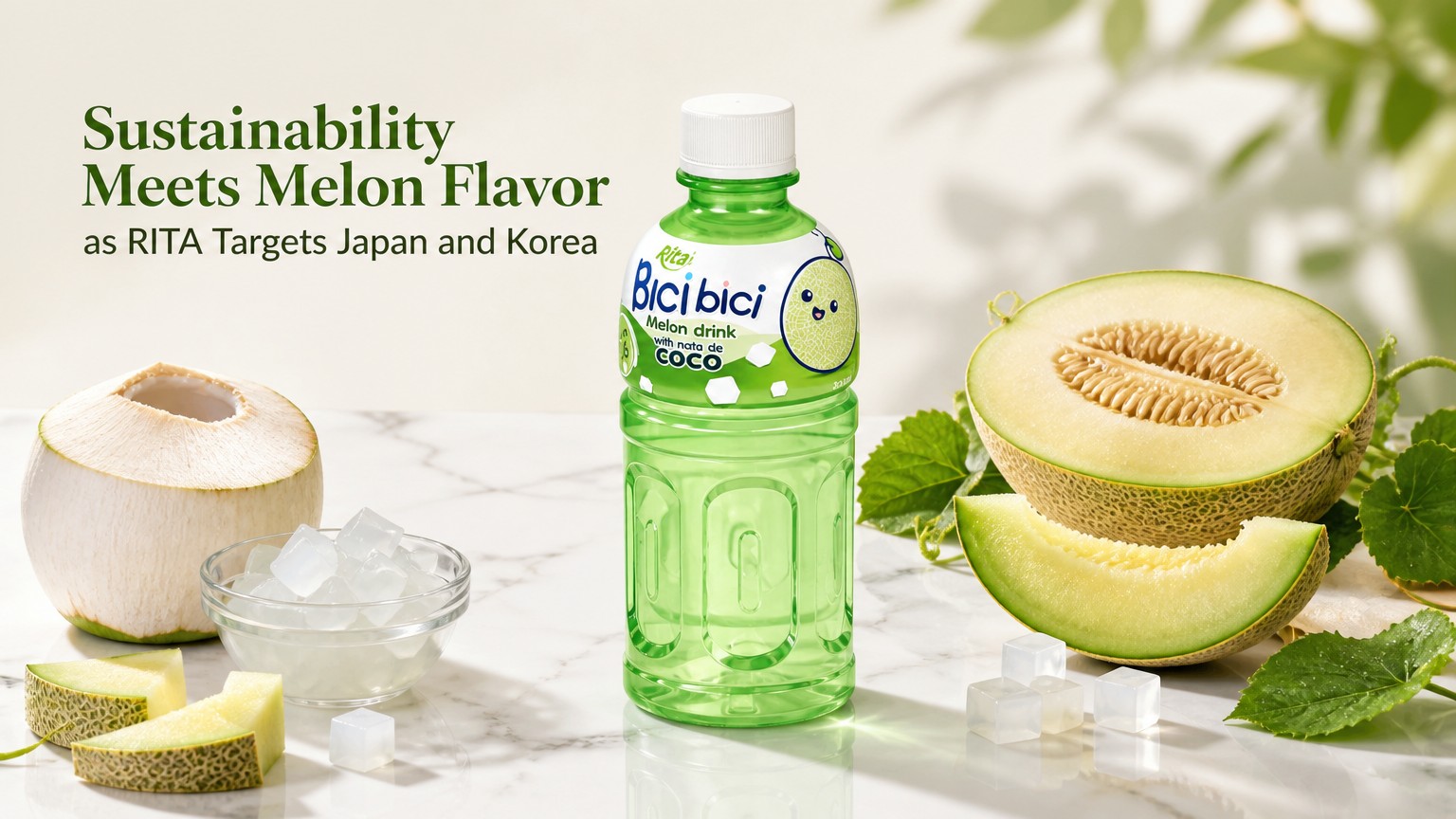
Sustainability Meets Melon Flavor as RITA Targets Japan and Korea
TABLE OF CONTENTS

The melon drink with nata de coco category is drawing fresh attention across Asia's flavored refreshment trade, and the Rita Bici Bici Melon Drink with Nata de Coco 320ml PET Bottle offers a timely lens on how Vietnamese manufacturers are pairing playful flavor with disciplined export practice. As procurement teams in Japan and Korea weigh packaging footprints, certification depth and delivery reliability, a single 320ml bottle reveals a great deal about where the wider beverage industry is heading.
Key Takeaways
- Texture-led beverages featuring nata de coco are moving from novelty status toward mainstream shelf presence in Asian markets.
- Sustainability considerations increasingly shape packaging, logistics and formulation choices for exporters serving Japan and Korea.
- RITA runs more than 50 automated production lines and ships over 1,200 containers monthly to 200+ countries and territories.
- Certifications such as FSSC 22000, BRC, HACCP, ISO 22000 and Halal underpin buyer confidence in regulated import markets.
- Flexible MOQ, OEM/ODM capability and 20 to 25 day lead times give distributors room to trial the 320ml PET format.
Why the Melon Drink with Nata de Coco Is Turning Heads in Asia
Consumer curiosity across the region is being driven less by novelty alone and more by the way a drink feels in the hand and on the palate. Chewy, translucent and self-explanatory, this format asks little of the shelf talker.
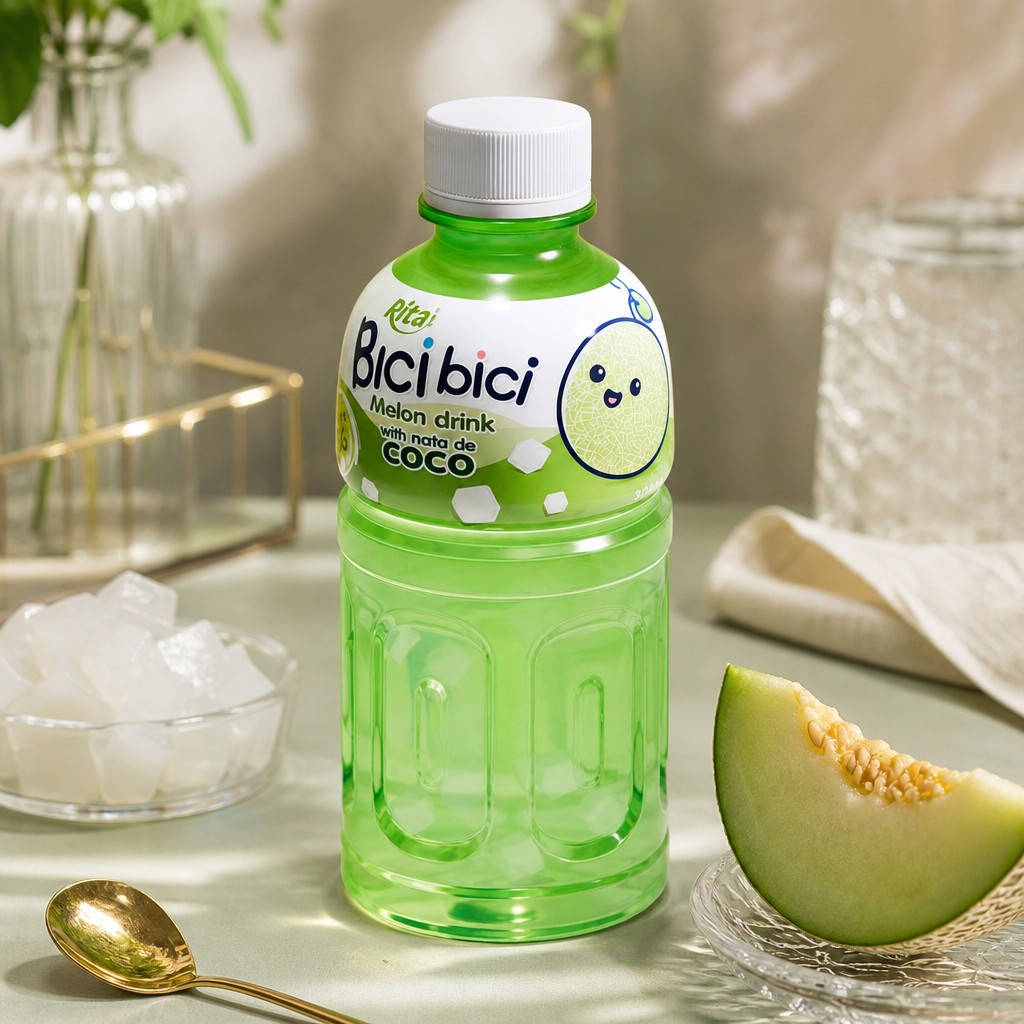
The Rita Bici Bici Melon Drink with Nata de Coco 320ml PET Bottle pairs a pale green, translucent liquid with suspended cubes of coconut gel, so two distinct textures arrive in a single sip. The container itself is clear PET topped with a white screw cap, and the label carries a cheerful melon character set against hexagonal motifs that echo the nata de coco pieces inside. On a Japanese konbini cooler or a Korean convenience-store chiller, that visual language reads instantly, which matters when impulse decisions are made in seconds. For importers, the bottle geometry also stacks predictably inside export cartons, a quiet advantage when freight is priced container by container.
Texture as a Differentiator
Chewy inclusions have travelled a long way from their origins in Southeast Asian dessert drinks, and they now appear in ready-to-drink formats sold well beyond the Mekong region.
Retailers covering the category report that shoppers enjoy the small pause a solid inclusion creates mid-sip, a micro-experience that a flat liquid cannot replicate. In a segment where flavor profiles converge quickly, texture has emerged as the more durable point of difference, and it costs nothing extra to communicate on-pack.
Melon Notes and Regional Taste Memory
Melon carries unusually strong recognition in both Japanese and Korean flavor libraries, where musk melon and honeydew references recur across confectionery, dairy and seasonal promotions.
That familiarity lowers the barrier to trial for a new imported SKU, because the shopper already holds a mental picture of what the drink should taste like. The sweetness here is rounded rather than sharp, and the coconut gel softens the finish, giving the beverage a dessert-adjacent quality without tipping into heaviness. For category managers, the profile sits comfortably beside iced teas, juices and flavored waters rather than competing head-on with carbonated colas.
The result is a product that largely explains itself at the point of sale, with no training required for store staff.
Sustainability Reshaping Beverage Packaging Decisions
Packaging has become the first question on many buyer checklists, and the answer increasingly determines whether a sample ever leaves the factory gate.
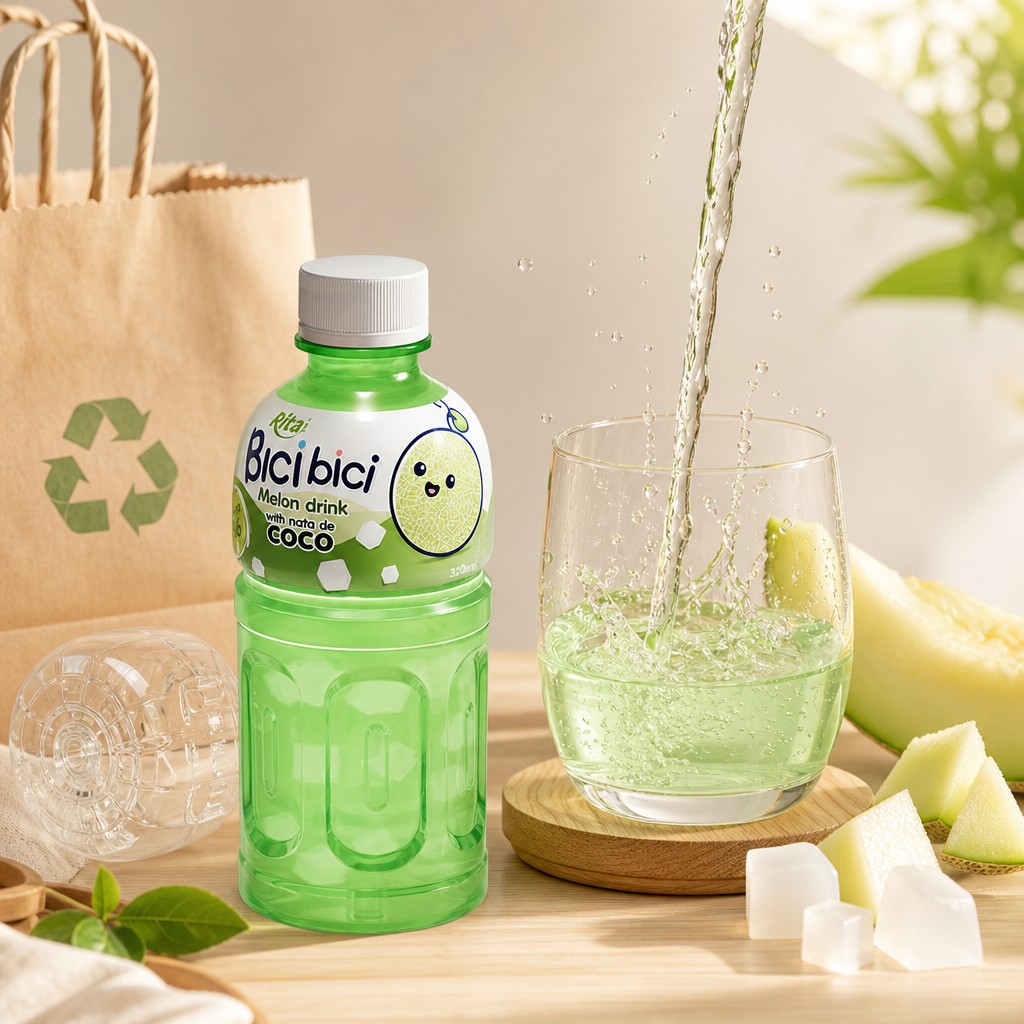
A 320ml PET bottle of the melon drink with nata de coco weighs a fraction of an equivalent glass container, which translates into lower transport emissions per unit shipped. PET is also among the most widely collected resins in Japan and Korea, where deposit-return and container-selection schemes already route large volumes of plastic bottles back into the material stream. Choosing a lightweight, mono-material format therefore simplifies the end-of-life story for retailers that must report packaging recovery figures to head office, and it gives sustainable beverage packaging a concrete rather than aspirational meaning.
Lightweight Formats and Freight Efficiency
Weight savings compound across a 20-foot container, and the arithmetic favors lighter bottles every time a shipment is planned.
Lighter units mean more bottles per container and less fuel burned per case delivered to a distribution centre in Osaka or Busan. RITA's stated supply ability of roughly 600 twenty-foot containers per month gives buyers the scale to plan consolidated loads rather than chase spot shipments. An 18-month shelf life further reduces the risk of write-offs during slow seasonal ramps, because product that sells rather than spoils never becomes waste. Flexible minimum order quantities let a distributor test the format in one city before committing to a regional rollout.
| Format | Unit weight | End-of-life stream in Japan and Korea | Shelf-life profile |
|---|---|---|---|
| 320ml PET bottle (this product) | Light | Mature bottle-to-bottle recycling | 18 months |
| Glass bottle | Heavy | Established collection, energy-intensive reprocessing | Long |
| Aluminum can | Light | High scrap value, well-developed return systems | Moderate |
| Flexible pouch | Very light | Limited collection streams | Moderate |
The comparison above frames the main packaging choices a buyer weighs when placing a first order in this category.
Sustainability in this category also reaches the label. The formulation centers on a melon flavor base and coconut gel inclusions, which keeps the ingredient statement compact and legible for shoppers who scan panels before buying. Shorter copy in turn makes multilingual artwork for Japanese and Korean shelves easier to lay out without redesigning the bottle from scratch, saving artwork revisions during the launch window.
From Coconut Gardens to the Bottle: Raw Material Sourcing
The chewy cubes inside every bottle begin far from any bottling hall, in coastal coconut gardens and open-field melon plots.
Nata de coco is derived from coconut water, and RITA's relationship with the Ben Tre coconut farm keeps that raw material inside a documented chain of custody from plantation through to gel production. Ben Tre, long described as Vietnam's coconut capital, supplies the consistent, mature nuts that fermentation-based gel making depends on. Sourcing within a known geography also shortens the distance between harvest and processing, which matters for a manufacturer shipping more than 1,200 containers a month.
Melon sourcing, meanwhile, draws on the Mekong Delta raw material area, where field teams assess fruit quality before any flavor base is specified for a production run. Keeping that evaluation close to the growing region gives research staff earlier feedback on sugar levels, aroma and color, the three attributes that most shape a melon profile in the finished drink.
A short field visit offers a closer look at how raw material quality is monitored in practice: https://www.youtube.com/watch?v=I7hlTL3FT_0
Traceability of this kind is no longer optional. Buyers in Japan and Korea increasingly ask for documentation of origin and handling before a first order is placed, and the ability to trace a bottle back to a named growing area shortens that conversation considerably.
Certification and Logistics Behind the Melon Drink with Nata de Coco
For import markets with dense regulatory frameworks, paperwork is the gatekeeper, and this product arrives with the right set of keys.
The melon drink with nata de coco is produced under a certification portfolio that includes FSSC 22000, BRC Food, HACCP, ISO 22000, GMP and Halal approvals covering both Jakim and GCC schemes. Those credentials matter in practice: a Korean importer screening a new supplier will usually request food-safety documentation before discussing price, and a Japanese buyer will expect traceability records to travel with the first shipment. Having the paperwork ready at sample stage can remove weeks from the qualification cycle.
Certifications That Clear Import Hurdles
Certifications do not sell the drink, but their absence can stop a listing before it starts.
| Certification | What it signals to a buyer |
|---|---|
| FSSC 22000 | Food safety management verified against a globally recognized scheme |
| BRC Food | Standard accepted by major UK and European retail chains |
| HACCP | Hazard analysis embedded in day-to-day processing controls |
| ISO 22000 | Structured food safety management system across the site |
| GMP | Good manufacturing practice conditions maintained on site |
| Halal Jakim and HCA-GCC | Acceptability for markets that require Halal certification |
The table lists the certifications referenced for this product alongside the buyer questions each one tends to answer.
Behind the documents sits RITA Food and Drink Co., Ltd, established in 2004 and now a leading Vietnam beverage exporter with OEM and ODM capability serving more than 200 countries and territories. The company's OEM beverage manufacturing footprint spans more than 50 automated production lines, in-house research and development, and private-label support for buyers who want their own branding on the shelf. Full specifications for the 320ml PET melon drink listing, including payment terms, delivery windows and packaging details, are published on the product page.
Ingredient-wise, the coconut gel component connects directly to RITA's coconut products catalog, where coconut water, coconut milk and related items sit alongside the nata de coco line. Buyers assembling a tropical assortment can therefore consolidate several items with one supplier rather than juggling separate contracts and certification files.
Business Outlook for Distributors and Private Label Partners
Opportunity here is less about chasing a fad and more about securing repeatable supply at a predictable cost.
Private-label demand has been steady across the region, and RITA's OEM service programme lets distributors place their own artwork, language variants and case configurations on an established 320ml PET platform. Lead times of 20 to 25 days after order confirmation keep PET bottle export to Japan and Korea on a predictable schedule, with FOB Ho Chi Minh Port and payment by L/C or T/T forming a familiar commercial framework for Asian traders. The same platform carries other flavors in the Bici Bici line, including chocolate, coffee, honey and strawberry, so a buyer can widen the range without onboarding a second factory.
- Volume: 320ml in a PET bottle with an 18-month shelf life
- Minimum order quantity: flexible, sized to the buyer's test plan
- Delivery: 20 to 25 days after order confirmation, FOB Ho Chi Minh Port
- Payment: L/C or T/T, with free samples available on request
Category context supports the push. Non-alcoholic refreshment continues to take shelf space as drinkers in Japan and Korea spread purchases across more occasions, and a melon drink with nata de coco fits that expansion naturally, positioned between iced teas and flavored waters rather than in direct competition with carbonates.
Wider drinks industry headlines underline why dependable supply matters. Recent coverage has focused on disruption among producers, including further strikes at Diageo's Cameronbridge distillery, a paused production run at Scotland's Holyrood distillery, the planned sale of Australian Vintage's Nepenthe cellar door and vineyard, and the closure of Diageo's Guinness Open Gate site in the United States. Those stories belong to the spirits and wine world, but they illustrate how quickly capacity and continuity can shift, a reminder for soft drink buyers to lock in suppliers with documented output rather than relying on spot availability.
For buyers ready to move, the full specification page for the 320ml PET bottle carries packaging, shelf life and certification details, while the soft drink range shows how the same format extends across flavors and formulations.
Frequently Asked Questions
What is the Rita Bici Bici Melon Drink with Nata de Coco?
It is a 320ml PET bottled beverage that combines a sweet, rounded melon flavor with chewy cubes of nata de coco, giving drinkers two textures in one sip. It is manufactured by RITA Food and Drink Co., Ltd in Vietnam and exported to more than 200 countries and territories.
What packaging does the melon drink use?
The product is filled in a clear 320ml PET bottle with a white screw cap and carries an 18-month shelf life. PET is lightweight for freight and is widely collected through bottle recycling schemes in Japan and Korea.
Which certifications support export of this drink?
The product is produced under FSSC 22000, BRC Food, HACCP, ISO 22000, GMP and Halal approvals, placing it within RITA's Halal certified soft drinks range. Documentation is available at sample stage to speed up buyer qualification.
Can the product be supplied under OEM or private label?
Yes. RITA offers OEM and ODM services with flexible minimum order quantities, custom artwork and language variants on the established 320ml PET platform. Other flavors in the Bici Bici line include chocolate, coffee, honey and strawberry.
What are the delivery terms for Japan and Korea?
Delivery is quoted at 20 to 25 days after order confirmation, FOB Ho Chi Minh Port, with payment by L/C or T/T. Free samples are available for buyers evaluating the nata de coco coconut drink before placing a first order.