

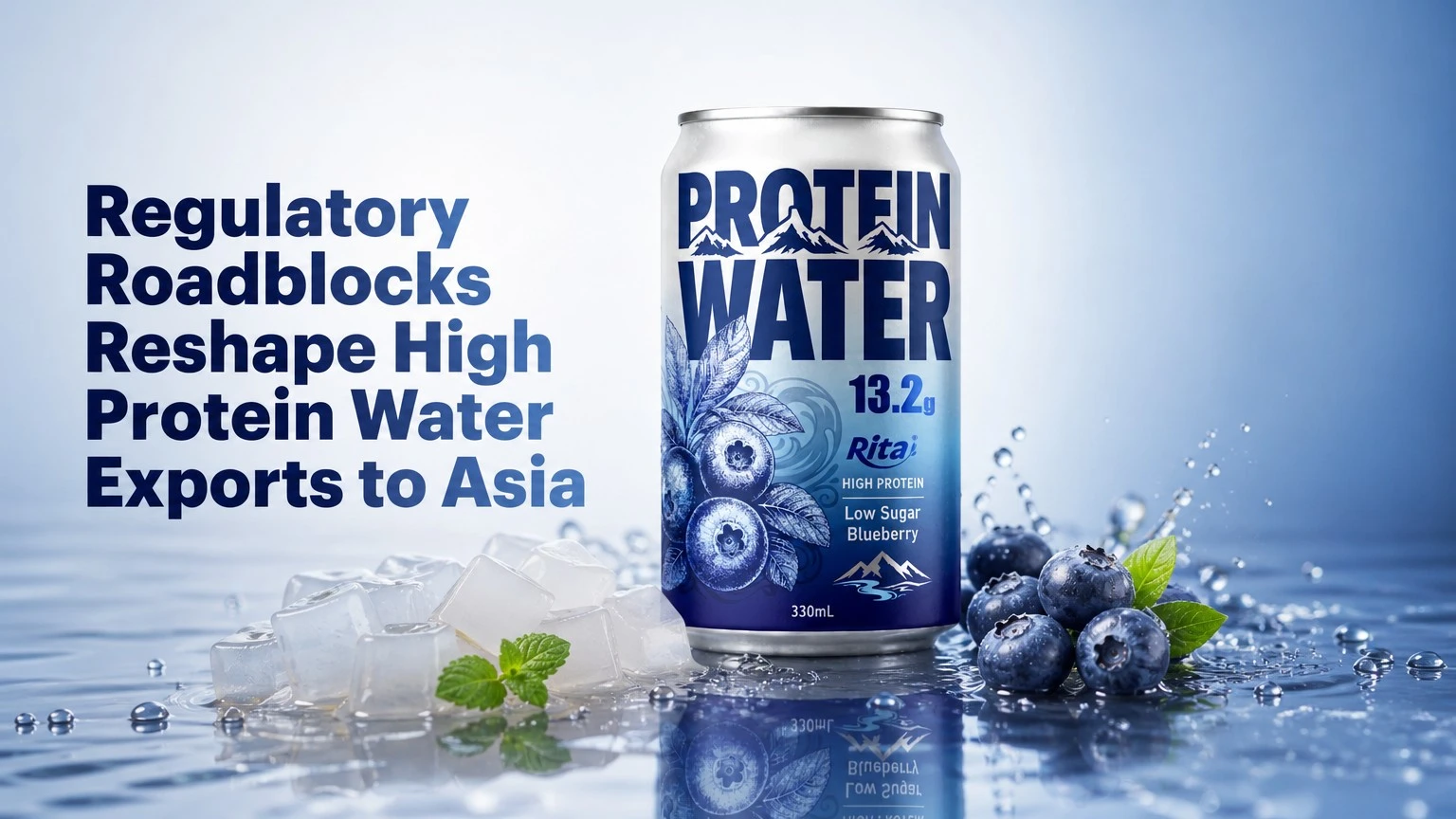
Regulatory Roadblocks Reshape High Protein Water Exports to Asia
TABLE OF CONTENTS
-
- What certifications should an Asian importer verify before buying high protein water from a Vietnamese supplier?
- Why do specification values like pH and Brix matter in export purchasing?
- How does aluminum can packaging affect shelf life for protein beverages?
- Can RITA support private label and OEM development for Japanese and Korean buyers?
- What are typical lead times and order requirements for export from Vietnam?

Regulatory scrutiny is reshaping the global beverage trade, and few categories face more intense document review than high protein water entering the Japanese and South Korean markets. Importers across Tokyo, Seoul, Osaka and Busan now verify ingredient declarations, shelf-life evidence and processing certifications long before a single container clears customs. Vietnamese manufacturer RITA Food and Drink Co., Ltd., established in 2004, supplies brands across more than 180 countries and has structured its entire export operation around this documentation-driven purchasing culture, making the compliance conversation more relevant than ever for Asian buyers.
Key Takeaways
- Japan and South Korea enforce some of the world's most rigorous import documentation requirements for processed beverages, including protein-enhanced drinks in aluminum cans.
- Recognized certifications such as FSSC 22000, BRC, HACCP, ISO 22000 and GMP are now treated as baseline market-entry credentials rather than optional marketing assets.
- RITA Food and Drink Co., Ltd. operates more than 50 automated production lines and exports over 1,200 containers monthly, giving buyers the scale and audit trail required for repeat orders.
- Product specifications such as pH 4.1±0.5, Brix 10.6±0.5 and a 24-month shelf life are treated by Asian importers as contractual quality anchors, not just technical footnotes.
- The high protein water blueberry drink offered by RITA targets the exact premium, low-sugar positioning that Korean and Japanese retail buyers are currently expanding.
Regulatory Frameworks Shaping High Protein Water Exports to Japan and South Korea
Both Japan and South Korea operate import regimes that place the burden of proof squarely on the foreign manufacturer, and for functional beverage categories the paperwork demands are unusually dense. A supplier cannot simply send a certificate of analysis; it must present traceable records linking raw-material lots to finished aluminum can production, storage conditions and shipping documentation.
Japan's Import Inspection and Labeling Expectations
Japan's Ministry of Health, Labour and Welfare oversees food import verification through a layered system that combines prior notification, laboratory analysis and on-site inspection where risk is elevated. Protein-enhanced beverages typically attract attention because the category sits between conventional soft drinks and nutrition supplements, meaning that claims, sweetener usage and colorant declarations must all align with the importer's registered product profile. Buyers distributing in Hokkaido or Kyushu often require English and Japanese label artwork simultaneously, plus English-language technical dossiers that mirror the final packaged specification exactly. Even a minor mismatch between the declared Brix value and the measured Brix in the finished can can trigger a rejection, which is why RITA's published standard of Brix 10.6±0.5 is treated as a serious procurement specification rather than marketing copy.
South Korea's Certification-Driven Market Entry
South Korea's Ministry of Food and Drug Safety leans heavily on internationally recognized food safety schemes, and retail chains in Seoul and Incheon routinely request certification evidence before granting shelf space. Korean buyers evaluating a high protein water blueberry drink are typically interested in three things at once: a credible Halal credential for broader distribution, a globally audited food safety system, and a manufacturer that can sustain monthly volume without variance. This combination is precisely what a diversified exporter like RITA brings to the table, since the company holds BRC, FSSC 22000, Halal Jakim, Halal HCA-GCC, Kosher, ISO, GMP, HACCP and SMETA credentials across its production network.
Certification Credentials That Unlock Asian Retail Channels
Certification is no longer a differentiator in East Asian beverage procurement; it is the entry fee. Retailers and distributors use third-party audit reports as a proxy for operational maturity, and they expect the certificate scope to cover the exact production lines, packaging formats and raw-material categories relevant to the product being purchased.
From HACCP to FSSC 22000 and BRC
HACCP remains the foundational requirement across virtually every Asian import channel, but buyers now layer additional schemes on top of it. FSSC 22000, which harmonizes ISO 22000 food safety management with Global Food Safety Initiative benchmarking, is widely regarded as one of the most comprehensive credentials available to a beverage manufacturer. BRC certification adds a further dimension that matters to distributors handling multiple SKUs across different regions, since it audits not only product safety but also quality management, site standards and traceability. A useful way to visualize the certification landscape for a protein beverage export program is as follows.
| Credential | What Importers Verify | Relevance to Asian Markets |
|---|---|---|
| FSSC 22000 | End-to-end food safety management system | Highly valued by Korean and Japanese procurement teams |
| BRC Food | Quality management, site standards, traceability | Preferred for multi-SKU distribution agreements |
| Halal Jakim / HCA-GCC | Ingredient sourcing and process suitability | Supports broader regional distribution beyond core markets |
| ISO 22000 / GMP | Documented management systems and production controls | Standard expectation for repeat container orders |
| SMETA | Ethical audit and responsible sourcing practice | Increasingly requested by European-aligned retail groups |
It is worth noting that only some certifications formally apply to a given SKU, and RITA publishes this distinction openly on its product listings so that buyers can request the specific certificate set they need for their jurisdiction rather than receiving an undifferentiated document bundle.
Formulation Consistency and Labeling Accuracy as Compliance Anchors
For protein-enriched beverages, formulation stability is a compliance issue as much as a sensory one. Any drift in pH, sweetness level or protein content creates a documentation gap the moment the measured values no longer match the specification sheet shipped with the container. That is why buyers in Daegu and Daejeon increasingly treat laboratory verification of incoming shipments as routine rather than exceptional.
Reading the Specification Sheet
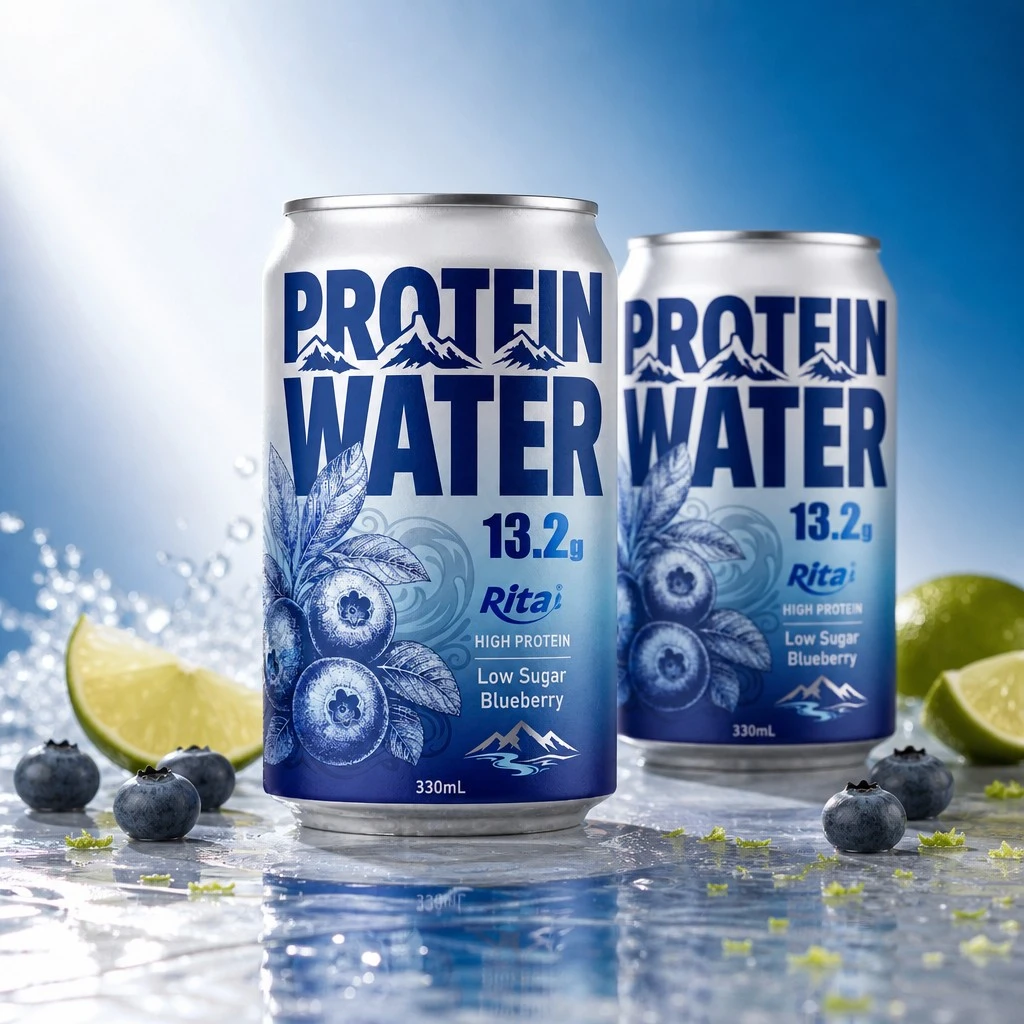
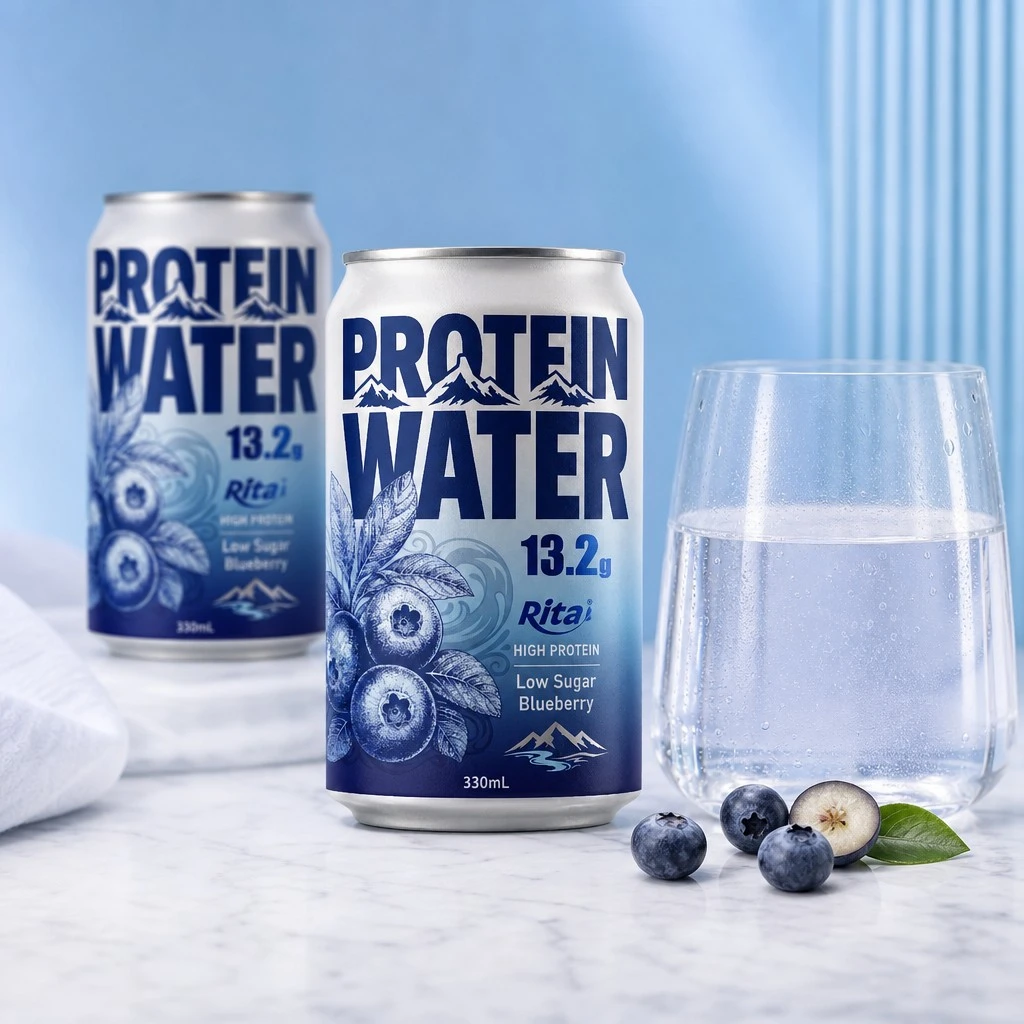
The RITA High Protein Water Blueberry Drink carries a 13.2g protein designation across a 330ml aluminum can and reports 102 kcal per container, with a formulation built around water, sugar, clear pea protein and blueberry flavor. Its published technical profile includes a pH of 4.1±0.5 and a Brix reading of 10.6±0.5, figures that give quality teams a concrete reference point for incoming inspection. The low-sugar positioning is significant commercially: consumers across Korea and Japan increasingly describe their preferred packaged drinks in terms of sugar content, and retailers report that clear on-pack nutrition statements drive shelf comparison more reliably than flavor imagery alone.
Blueberry flavoring also introduces a sensory expectation that must be held constant across production runs. A clear pea protein base delivers a light, transparent appearance, so any variation in the blueberry profile becomes immediately visible to the consumer. Manufacturers addressing this challenge typically lock the flavor standard at the moment of formulation approval and then verify it against retained samples from every production batch, a practice that RITA embeds within its documented quality procedures.
Packaging Standards, Shelf Life and Cold-Chain Expectations
Aluminum cans remain the dominant packaging choice for high protein water because they protect light-sensitive formulations while supporting the tall, slim retail formats that Korean and Japanese consumers associate with modern functional beverages. The 330ml format used by RITA fits neatly into convenience store cooler space across Tokyo and Seoul, where chilled ready-to-drink placements dominate the category.
Shelf life carries equal weight in procurement decisions. RITA specifies a 24-month shelf life for this product, a figure that allows importers to build buffer stock without compressing their sell-through window. For buyers operating warehouses in cooler climates such as Hokkaido or in high-turnover urban districts such as Incheon, that buffer directly influences how much safety stock they are willing to hold per SKU, which in turn determines the order quantity economics that make an export program viable.
Export Market Outlook for High Protein Water in Asia
Broader industry signals point to continued structural growth in the packaged protein beverage segment across East Asia. Industry reporting has highlighted the so-called better-for-you sports drink category as an area of significant expansion potential, while major beverage companies continue to consolidate operational leadership around categories that combine convenience with a clear on-pack positioning. Importers reading these trends tend to respond by widening their supplier search rather than by raising barriers alone, which creates a meaningful opening for exporters able to present both certification and volume.
For a manufacturer such as RITA, positioned at the Ho Chi Minh Port of Vietnam with a supply capability of around 600 twenty-foot containers per month, the practical appeal is straightforward. Buyers can run a pilot order of a few containers, expand into a full container program, and then scale across multiple retail banners without needing to change manufacturing partners. The company's private label and OEM/ODM infrastructure further supports this path, since buyers who want to develop their own high protein water line under local branding can access formulation support, artwork development and packaging design through a single supplier relationship.
Where Japanese and Korean Buyers Are Concentrating
Across Japan's main islands — Honshu, Hokkaido, Kyushu and Shikoku — purchasing activity for ready-to-drink functional beverages is concentrated around regional distribution networks rather than a single national wholesaler, meaning that a successful export program typically requires documentation and labeling assets tailored to each region's preferences. South Korea presents a somewhat different structure, with buying decisions in Seoul, Busan, Incheon, Daegu, Daejeon and Gwangju more heavily influenced by large retail and convenience chains that standardize their certification requirements. In both markets, the pattern is consistent: buyers want a partner who can demonstrate regulatory maturity on paper and then prove it across every delivered container.
Distribution across these markets also benefits from the range of packaging formats available from a single manufacturer. RITA produces beverages in aluminum cans, glass bottles, PET bottles and PP bottles, which means an importer exploring the Energy Drinks Series for one channel and the Milk Series for another does not need to qualify two separate supply chains. The same production infrastructure, the same certification suite and the same quality documentation apply across the portfolio.
Building Reliable Supply Chains for Asian Functional Beverage Buyers
Regulatory readiness only converts into commercial value when the supply chain behind it is dependable. This is where manufacturing scale becomes the decisive variable, because a certification certificate is only as useful as the factory's ability to deliver consistent product week after week, month after month, across the full length of a distribution contract.
Operations detail matters here. RITA reports more than 50 automated production lines and monthly exports exceeding 1,200 containers, with published supply capacity of around 600 twenty-foot containers per month against a flexible minimum order quantity and standard payment terms of L/C or T/T on FOB terms. Typical lead time from order confirmation sits at 20 to 25 days, a window that gives regional distributors in Busan and Fukuoka enough planning space to schedule container arrivals against promotional calendars.
For buyers, the practical next step is usually a technical review rather than a sales conversation. Requesting the applicable certificate set, the full specification sheet, sample cans for shelf testing and a container-level quality plan is a standard part of qualifying any new Asian export partner, and it is exactly the kind of documentation the high protein water blueberry drink listing at RITA is designed to support. Importers who move early in this process tend to secure better allocation during high-demand quarters, since manufacturers prioritise partners who have completed their compliance review before volume commitments are made.
Frequently Asked Questions
What certifications should an Asian importer verify before buying high protein water from a Vietnamese supplier?
Importers should confirm that the supplier holds HACCP, ISO 22000, GMP and one or more globally recognized schemes such as FSSC 22000 or BRC Food, with certificates whose scope covers the specific production lines, packaging format and raw-material categories used for the product being ordered. Halal credentials should be requested separately where wider regional distribution is planned, since not every certification formally applies to every SKU.
Why do specification values like pH and Brix matter in export purchasing?
Published values such as pH 4.1±0.5 and Brix 10.6±0.5 act as contractual quality references. When the measured values in the delivered aluminum cans match the specification sheet, incoming inspection passes smoothly. Drift in either figure signals an inconsistency that importers must document, and in tightly managed retail environments it can result in shipment rejection.
How does aluminum can packaging affect shelf life for protein beverages?
Aluminum cans provide an effective barrier against light and oxygen, which helps preserve the sensory profile of a clear pea protein formulation over time. RITA specifies a 24-month shelf life for the High Protein Water Blueberry Drink, giving importers in climate-diverse regions such as Hokkaido or Seoul the buffer needed to manage safety stock effectively.
Can RITA support private label and OEM development for Japanese and Korean buyers?
Yes. RITA Food and Drink Co., Ltd. operates as an OEM and ODM manufacturer with advanced R&D and private label services, allowing buyers to develop branded high protein water lines under local naming, artwork and formulation directions. The company produces beverages across aluminum cans, glass bottles, PET and PP bottles, which supports multi-format distribution from a single manufacturing partner.
What are typical lead times and order requirements for export from Vietnam?
Standard lead time is 20 to 25 days from order confirmation, with FOB Ho Chi Minh Port shipping, flexible minimum order quantities and payment terms available under L/C or T/T arrangements. Buyers interested in export volume programs can review current supply capacity and container availability directly through RITA's product listing and export desk.