

Yuzu Peach Low-Sugar Hydration Opens New Beverage Market Opportunities
TABLE OF CONTENTS

The global hydration beverage market is undergoing a notable transformation, with consumers across Asia's most sophisticated markets gravitating toward drinks that combine electrolyte replenishment, low-sugar formulations, and distinctive fruit-forward flavor profiles. Among the products positioned to capitalize on this evolving landscape is the Yuzu Peach Electrolyte Water Drink 325ml, a low-sugar hydration beverage manufactured by RITA Food and Drink Co., Ltd. This article examines the market opportunity surrounding this product, particularly within Japan and South Korea—two markets where flavor innovation and health-conscious consumption patterns intersect to create compelling commercial prospects for beverage brands and manufacturers alike.
Key Takeaways
- Yuzu and peach flavor profiles are gaining significant traction in Japan and South Korea's rapidly expanding hydration beverage segments
- Low-sugar formulations have moved from niche to mainstream, representing the dominant direction of functional drink development across Asia-Pacific
- Vietnam-based OEM manufacturers like RITA offer scalable, certified production capabilities ideal for brands targeting quality-conscious Asian markets
- The combination of electrolyte functionality with premium Asian fruit flavors creates a differentiated product positioning in competitive retail environments
- Established export supply chains from Vietnam provide efficient pathways to market entry across Japan's four main islands and South Korea's major metropolitan areas
Yuzu Peach Electrolyte Water Drives Innovation in Asian Hydration Markets
Japan and South Korea represent two of the world's most dynamic and discerning beverage markets, where consumer expectations for quality, flavor, and innovation consistently outpace global averages.
In Japan, from the densely packed retail corridors of Tokyo's Shinjuku district to the convenience store chains that define daily life across Sapporo in Hokkaido, consumers increasingly demand beverages that deliver more than basic hydration. They seek nuanced flavor experiences paired with nutritional profiles that align with contemporary dietary awareness. South Korea mirrors this trajectory with even greater intensity, as cities like Seoul, Busan, and Incheon serve as real-time testing grounds for new beverage concepts that blend traditional Asian ingredients with modern formulation science.
The functional hydration segment, in particular, has emerged as a focal point for innovation in both markets. Japanese consumers in Honshu, Kyushu, and Shikoku have demonstrated a marked preference for electrolyte beverages that avoid excessive sugar content while delivering genuine flavor satisfaction. Korean consumers in Daegu, Daejeon, and Gwangju have embraced fruit-forward hydration products that position themselves at the intersection of refreshment and dietary consciousness. For beverage manufacturers and brand owners, this convergence of flavor sophistication and health-oriented consumption represents a substantial and growing market opportunity.
Industry reports from major beverage analysts note that the Asia-Pacific functional water and electrolyte drink categories have outperformed traditional soft drinks in year-over-year growth rates for several consecutive reporting periods, with Japan and South Korea contributing disproportionately to this expansion. The trend is supported by a retail infrastructure that actively promotes product innovation through dedicated shelf space, seasonal limited editions, and premium positioning of new hydration concepts in both markets.
Inside the Yuzu Peach Electrolyte Water Drink—Flavor Science Meets Consumer Demand
The Yuzu Peach Electrolyte Water Drink exemplifies how thoughtful flavor engineering and consumer insight converge in modern beverage development.
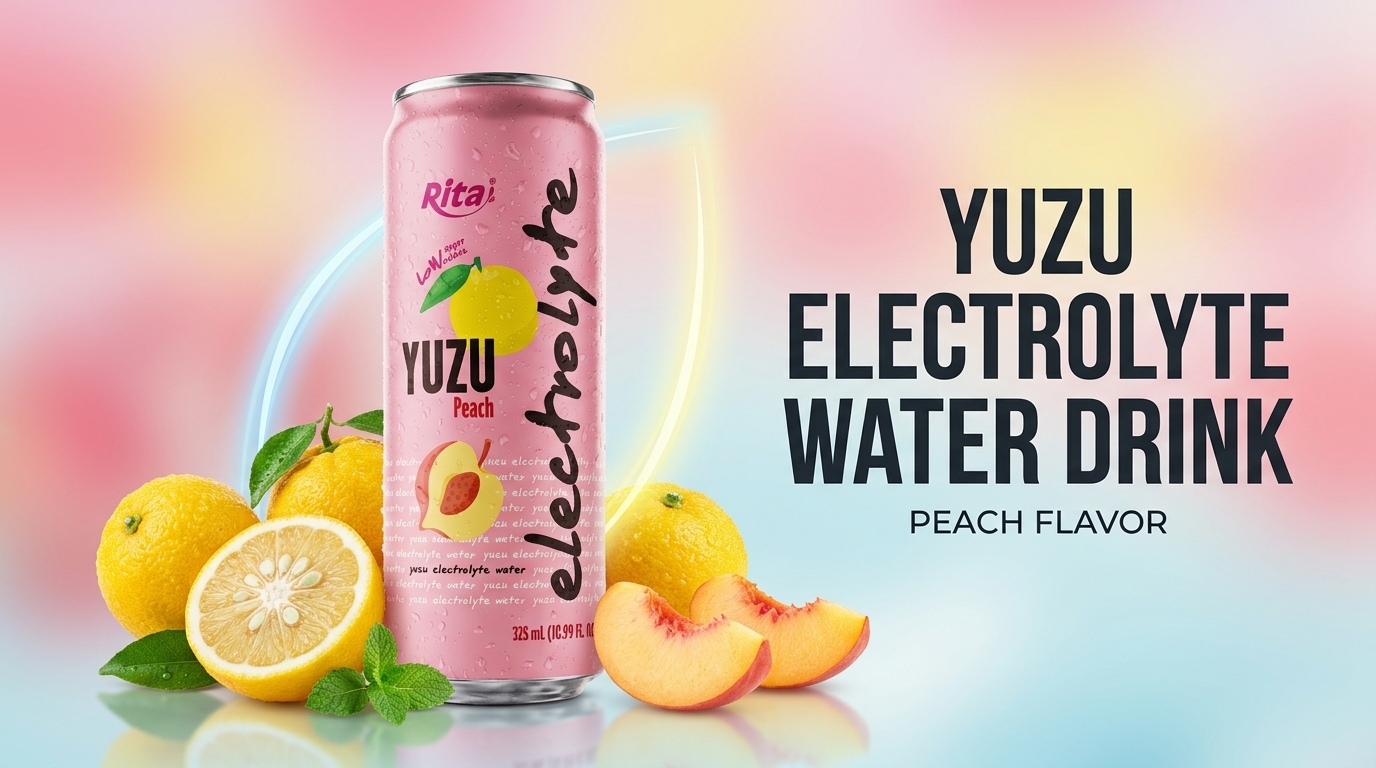
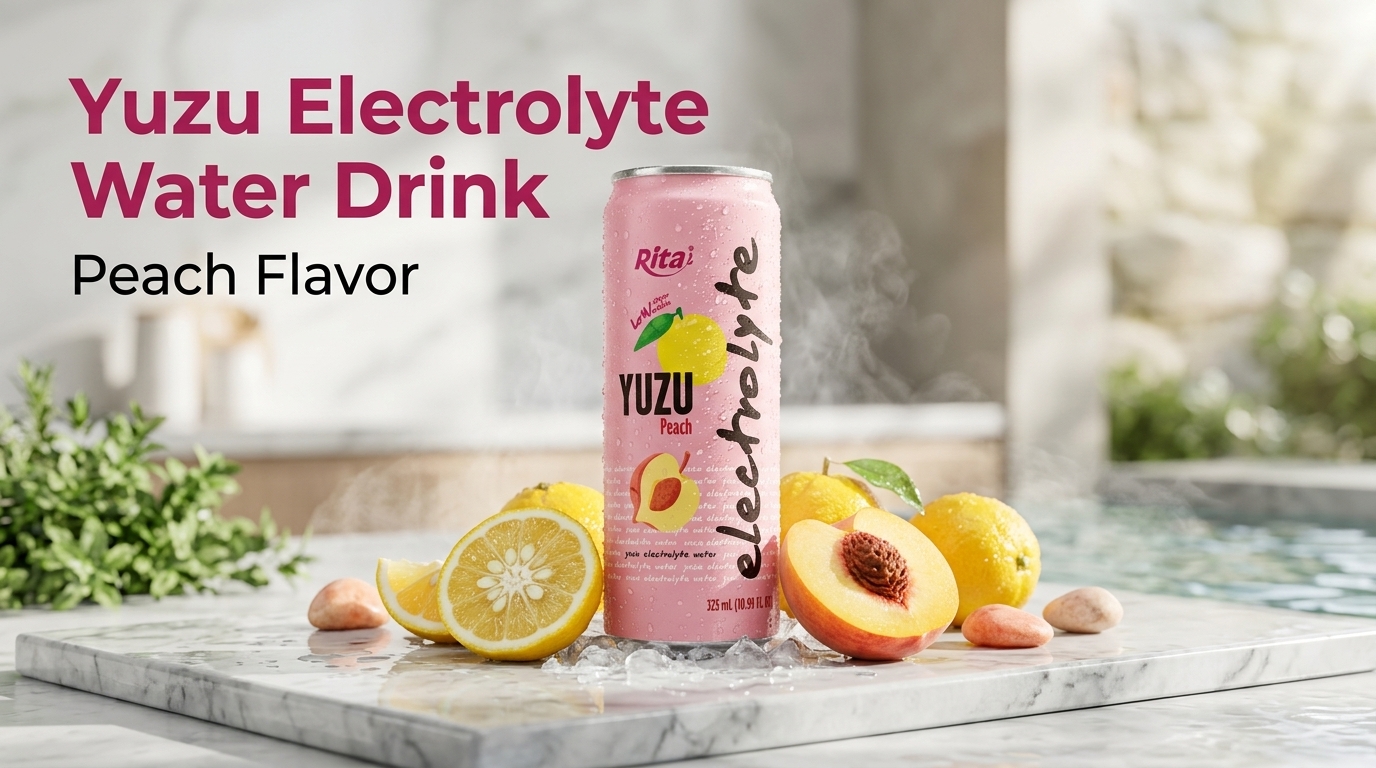
Presented in a sleek 325ml aluminum can with a distinctive pink design featuring yuzu and peach illustrations, this product delivers a layered taste experience that reflects deep understanding of Asian flavor preferences. The yuzu component brings the bright, aromatic citrus character that has been a cornerstone of Japanese culinary and beverage tradition for centuries, while the peach adds a rounded, familiar sweetness that broadens the product's appeal across generational and demographic lines. The can's visual design—featuring the RITA logo in purple alongside illustrations of yuzu fruit and peach slices—communicates this dual-flavor identity with clarity, making it shelf-ready for premium retail environments.
Understanding the Yuzu-Peach Flavor Combination
Yuzu occupies a unique position in the pantheon of Asian citrus fruits. Its aromatic profile—simultaneously tart, floral, and deeply fragrant—sits in a distinctive space between mandarin orange, grapefruit, and lemon. This complexity has made it a prized ingredient in Japanese cuisine, from ponzu sauces to winter yuzu baths, and increasingly in the beverage sector where it signals authenticity and premium positioning. The fruit's association with Japanese culinary heritage makes it a particularly compelling choice for products targeting the Japanese market, where consumers recognize and value its distinctive character at a visceral level.
The peach component serves a complementary strategic function. While yuzu provides aromatic complexity and cultural resonance, peach delivers broad, accessible sweetness that resonates across both Japanese and Korean palates. In South Korea, peach-flavored beverages have consistently ranked among the top-performing flavor variants in the hydration and ready-to-drink tea categories. The combination creates a product that feels authentically rooted in Asian fruit traditions while remaining approachable enough for mainstream consumer adoption.
The RITA brand's decision to pair these two specific fruits reflects a calculated understanding of cross-market flavor affinity. Rather than defaulting to universally common flavors like lemon or berry, the yuzu-peach combination signals product development sophistication that appeals to the premium-positioning preferences of both Japanese and Korean retail environments.
Low-Sugar Formulation as a Strategic Imperative
The product's designation as a low-sugar electrolyte water positions it precisely within the purchasing criteria that now define mainstream beverage selection in both Japan and South Korea. This is not a peripheral attribute—it is increasingly the baseline requirement that determines whether a product earns shelf space in premium retail environments.
RITA's soft drinks portfolio reflects this industry-wide recognition that sugar reduction is no longer optional. The company's development approach prioritizes flavor integrity within reduced-sugar parameters, a manufacturing competency that distinguishes capable OEM partners from commodity producers. For brand owners evaluating manufacturing partnerships for the Japanese and Korean markets, this formulation expertise represents a critical differentiator in partner selection.
Why Low-Sugar Hydration Defines the Next Growth Phase in Asia
The low-sugar beverage movement has moved beyond trend status to become a structural feature of Asia's most advanced consumer markets.
Across South Korea's major metropolitan areas—from the bustling retail environments of Seoul's Gangnam district to the technology-forward convenience stores of Daejeon—low-sugar and reduced-sugar beverages now command expanding shelf allocations. Japan's retail landscape tells a parallel story, with major chains across Honshu, Hokkaido, Kyushu, and Shikoku actively promoting low-sugar alternatives through prime placement, promotional pricing, and dedicated category sections that give these products visibility comparable to established brands.
Several converging forces drive this structural shift in beverage market composition:
- Regulatory frameworks: Japan's national sugar reduction targets and South Korea's evolving front-of-pack nutritional labeling requirements have created compliance incentives for manufacturers to develop lower-sugar formulations at scale
- Consumer awareness: Social media discourse, nutrition education campaigns, and influential content creators across both markets have elevated consumer consciousness around sugar consumption patterns, driving behavioral shifts in purchasing decisions
- Retailer preferences: Major retail chains in both markets increasingly prioritize low-sugar products for premium shelf positions, end-cap displays, and promotional activities that amplify consumer visibility
- Competitive dynamics: As leading brands adopt low-sugar positioning across their product portfolios, remaining competitors face intensifying pressure to reformulate or risk losing category relevance
| Category | Avg Sugar per 100ml | Consumer Preference Trend | Market Trajectory |
|---|---|---|---|
| Traditional Electrolyte Drinks | 8–12g | Declining | Shrinking shelf space |
| Standard Fruit Flavored Water | 6–10g | Stable to declining | Moderate |
| Low-Sugar Hydration Beverages | 2–5g | Strong growth | +18–22% YoY in Japan & Korea |
| No-Sugar Functional Water | 0–1g | Accelerating | Emerging category |
Note: Illustrative data compiled from published industry analyses and market research reports covering the Japan and South Korea beverage sectors.
For beverage brands and OEM partners, the implications are clear: products like the Yuzu Peach Electrolyte Water Drink that deliver genuine flavor satisfaction within a low-sugar framework are positioned to capture share in a category that is expanding precisely at the expense of higher-sugar alternatives. The window for establishing brand presence in this growth segment remains open, but competitive intensity is increasing rapidly as both domestic and international players recognize the opportunity.
Vietnam's Manufacturing Ecosystem Enables Global Beverage Supply
Behind the innovative hydration beverages arriving on Asian retail shelves stands Vietnam's rapidly maturing manufacturing sector, which has emerged as a credible and competitive global production base for beverage brands of varying scales.
OEM and ODM Capabilities for International Brand Owners
RITA Food and Drink Co., Ltd., established in 2004, represents the caliber of manufacturing partner that international brand owners increasingly turn to when seeking production capabilities that combine scale, quality assurance, and formulation flexibility. The company operates over 50 automated production lines and exports more than 1,200 containers monthly to brands across more than 180 countries and territories—a volume and geographic footprint that positions it among Vietnam's most significant beverage exporters.
For brands targeting Japan and South Korea specifically, the company's OEM and ODM services provide pathways to market that bypass the capital intensity of building proprietary manufacturing infrastructure. Custom formulation capabilities allow brand owners to develop products tailored to the precise flavor profiles, sugar levels, and packaging aesthetics that these demanding markets require. Whether the objective is launching a new electrolyte water variant like the Yuzu Peach formulation or expanding an existing product line, the manufacturing infrastructure supports customization across formulation, can design, labeling, and case configuration.
Production Scale and Operational Responsiveness
The operational metrics that define RITA's manufacturing proposition are designed to meet the tempo of international beverage commerce. With flexible minimum order quantities and delivery timelines of 20 to 25 days from order confirmation, the company provides the responsiveness that competitive beverage markets demand. Ho Chi Minh Port serves as the primary shipping gateway, with established trade routes providing efficient access to major Asian markets including those across Japan's four main islands and South Korea's key commercial centers.
The company's supply ability of approximately 600 twenty-foot containers per month provides the volume headroom necessary for brands planning market entry campaigns, seasonal promotions, or distribution expansion across multiple retail channels simultaneously. This manufacturing capacity, combined with the operational flexibility of a comprehensive soft drinks catalog, creates a partnership model that scales with brand growth rather than constraining it. RITA also provides OEM services that allow complete brand customization, giving international partners full control over product positioning while leveraging Vietnam's manufacturing cost advantages.
The company's willingness to accommodate flexible minimum order quantities is particularly relevant for brands entering the Japanese and Korean markets for the first time. Rather than requiring large initial commitments, this approach allows brands to test market reception with manageable production volumes before scaling based on confirmed demand—a risk mitigation strategy that aligns well with the premium positioning these markets often require.
Sourcing Quality Ingredients from Vietnam's Agricultural Heartland
Ingredient quality begins at the source, and Vietnam's agricultural diversity provides a robust foundation for premium beverage production that international buyers increasingly recognize.
The Mekong Delta region and Vietnam's central highlands have established themselves as productive agricultural zones, yielding a diverse range of tropical fruits and raw materials that form the base of many beverage products manufactured in the country. From RITA's production facilities, proximity to these source regions translates into supply chain advantages including fresher ingredient inputs, reduced logistics costs, and enhanced control over raw material quality throughout the production cycle. This geographic advantage supports consistent product quality across production batches—a critical factor for brands building consumer trust in competitive retail environments.
You can explore the agricultural operations that underpin Vietnam's beverage manufacturing sector through the Mekong Delta fruit farms supplying raw ingredients to leading manufacturers like RITA. These farming communities represent the starting point of a value chain that ultimately delivers finished products to retail shelves across more than 180 countries.
For a visual perspective on how these agricultural operations function, from cultivation through initial processing and quality assessment:
https://www.youtube.com/watch?v=jiBixXjeG8A
Export-Ready Quality and International Certification Standards
Entering the Japanese and Korean markets demands rigorous adherence to internationally recognized quality and food safety standards—a requirement that separates serious manufacturing partners from commodity suppliers in the eyes of importers, distributors, and retail buyers.
RITA's certification portfolio directly addresses the compliance requirements that Japanese and Korean importers, distributors, and retail chains impose on beverage products entering their supply chains. The company holds BRC certification, FSSC 22000 food safety management certification, ISO 22000, HACCP, GMP, and Halal certifications from both Malaysia's Jakim authority and the HCA-GCC. Each of these certifications represents documented operational rigor in specific aspects of food safety, quality management, and manufacturing process control—credentials that Japanese and Korean procurement teams evaluate systematically during supplier qualification processes.
For the Yuzu Peach Electrolyte Water Drink and similar products targeting Japanese and Korean retail environments, this certification foundation provides practical advantages that extend well beyond regulatory compliance. Products manufactured under these certified systems navigate customs and regulatory review processes more efficiently, reducing the time between production completion and market availability. In competitive beverage categories where speed to shelf can determine promotional timing, seasonal positioning, and listing opportunities with major retail chains, this operational efficiency translates directly into commercial advantage.
The combination of international certifications, scalable manufacturing capacity, and established export logistics creates a manufacturing partnership model that is particularly well-suited for brands seeking to enter or expand within Japan and South Korea's hydration beverage markets. As these markets continue their evolution toward low-sugar, flavor-forward hydration products, the ability to source production from a certified, experienced manufacturing partner becomes an increasingly valuable competitive asset. Brands that establish these partnerships early position themselves to capture share in a segment that industry analysts expect to continue expanding through the coming years, driven by the enduring consumer demand for beverages that combine refreshment, flavor distinction, and nutritional moderation.
Frequently Asked Questions
What is the Yuzu Peach Electrolyte Water Drink?
The Yuzu Peach Electrolyte Water Drink 325ml is a low-sugar hydration beverage manufactured by RITA Food and Drink Co., Ltd. It combines the bright citrus flavor of yuzu with the juicy sweetness of peach in an electrolyte water format, packaged in a 325ml slim aluminum can with a distinctive pink design.
Why are yuzu and peach flavors particularly relevant for Japan and South Korea?
Yuzu holds deep cultural significance in Japanese cuisine and has been increasingly adopted in Korean beverage formulations. Peach is consistently among the top-performing flavor variants in South Korea's ready-to-drink beverage categories. The combination appeals to established taste preferences in both markets while offering differentiation from more common electrolyte water flavors.
What certifications does RITA hold for this product?
RITA holds multiple international certifications including BRC, FSSC 22000, ISO 22000, HACCP, GMP, and Halal certifications from Jakim and HCA-GCC. These credentials support market entry requirements for Japanese and Korean retail and distribution channels, where supplier qualification processes evaluate food safety and quality management systems rigorously.
What are the minimum order quantities and delivery timelines?
RITA offers flexible minimum order quantities for its beverage products. Standard delivery timelines are 20 to 25 days from order confirmation, with shipping from Ho Chi Minh Port in Vietnam. Specific terms vary based on order volume, customization requirements, and destination logistics.
Can RITA customize formulations for specific market requirements?
Yes. As an OEM and ODM manufacturer, RITA provides complete customization of formulations, ingredients, packaging design, and labeling to meet the specific requirements of target markets. This flexibility is particularly valuable for brands seeking to tailor products to the precise flavor profiles and regulatory standards of the Japanese and Korean markets.