

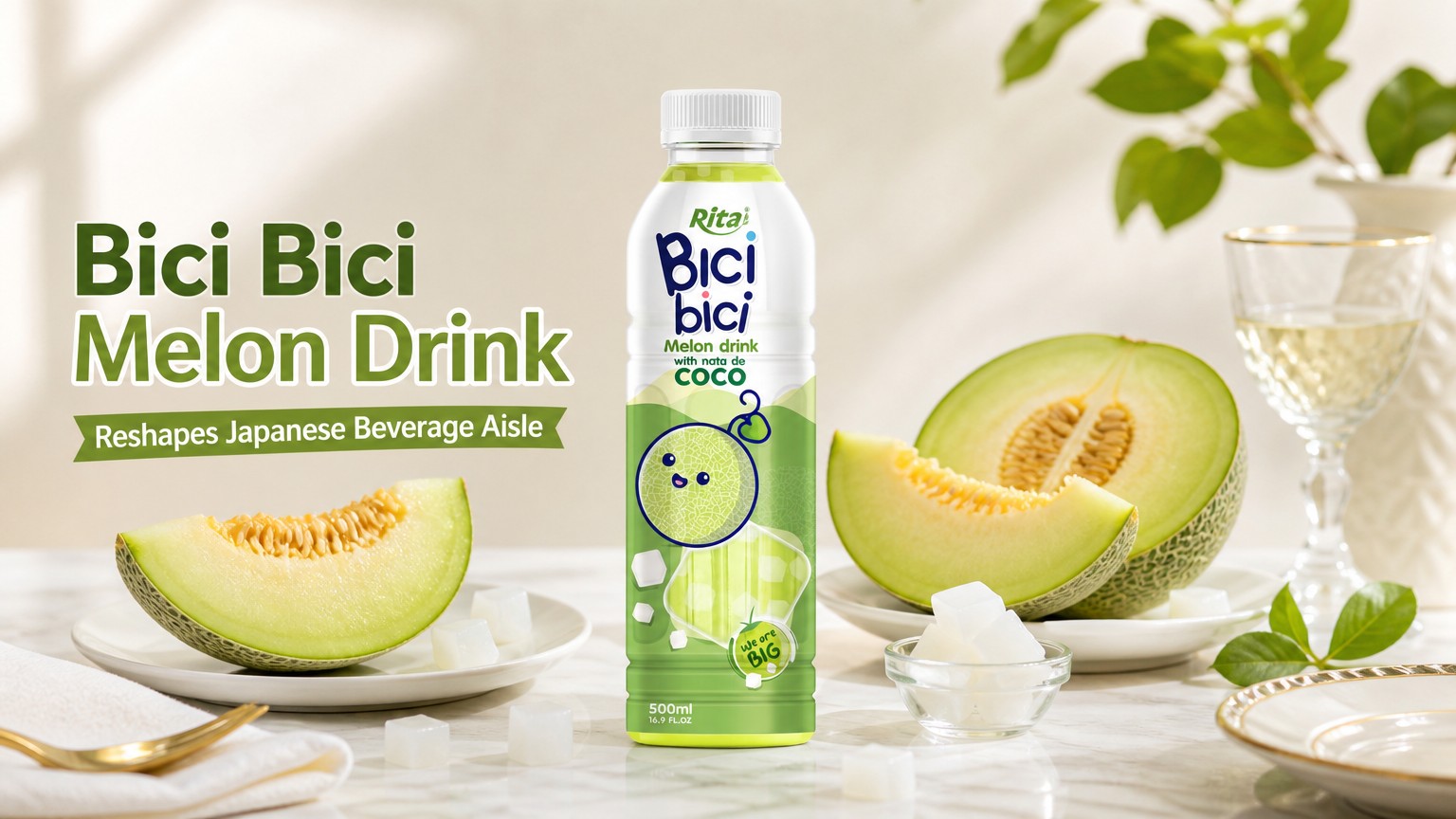
Bici Bici Melon Drink With Nata de Coco Reshapes the Japanese Beverage Aisle
TABLE OF CONTENTS

The Japanese beverage market has long been a proving ground for innovation. From functional waters to sparkling teas, consumers on the archipelago demand novelty, quality, and visual appeal in equal measure. Into this environment steps Rita Bici Bici Melon Drink with Nata de Coco, a ready-to-drink fruit beverage that merges a familiar melon sweetness with the playful chew of nata de coco. The 500 ml and 1 L PET bottle format positions it squarely for everyday consumption, while the concept itself reflects a broader shift in how Asian consumers experience drinks. Rather than simply sipping, they now expect texture, layered flavor, and a moment of enjoyment that goes beyond thirst.
For international buyers looking to source beverages that resonate in Japan and South Korea, the product represents a compelling case study. It is produced by RITA Food and Drink Co., Ltd, a Vietnamese OEM and ODM manufacturer that has been exporting to more than 200 countries and territories since 2004. The company operates over 50 automated production lines and ships more than 1,200 containers per month, giving it the scale and reliability that large retail chains in Tokyo, Osaka, Seoul, and Busan require from their suppliers.
Key Takeaways
- Texture-driven beverages are one of the fastest-growing sub-categories in Japan and South Korea, with nata de coco gaining traction as a differentiating ingredient.
- The 500 ml PET format aligns with Japanese convenience store culture, where single-serve grab-and-go drinks dominate shelf space.
- RITA Food & Drink Co., Ltd offers flexible MOQ, OEM, and private-label solutions, making it a practical sourcing partner for brands entering the East Asian market.
- Melon remains one of the most commercially important flavors in Japan, and pairing it with nata de coco creates a product story that is easy to communicate on shelf.
- Full international certifications — BRC, FSSC 22000, Halal, ISO, GMP, HACCP — cover the compliance requirements most Japanese and Korean retailers demand.
Why Texture Is the New Frontier in Asian Beverages
Texture has quietly become one of the most discussed topics in Asian beverage development. Consumer research published by Euromonitor and Nikkei Intelligence consistently points to a growing segment of drinkers — particularly in urban Japan and South Korea — who rank mouthfeel and physical sensation as key purchase drivers alongside taste and price.
Nata de coco, a gel-like food produced through the fermentation of coconut water, fits this trend perfectly. It adds a soft, satisfying chew without introducing strong flavors of its own, allowing the melon character of the Bici Bici drink to remain front and center. The ingredient has already proven its commercial viability across Southeast Asia, and Japanese retailers have begun stocking more SKUs that feature it.
For importers and distributors, the implication is straightforward. Beverages that combine a liquid base with a solid or semi-solid component are outperforming traditional juice-only formats in premium convenience channels. The Rita Bici Bici Melon Drink with Nata de Coco is built specifically to meet this demand.
What the Format Signals to Retail Buyers
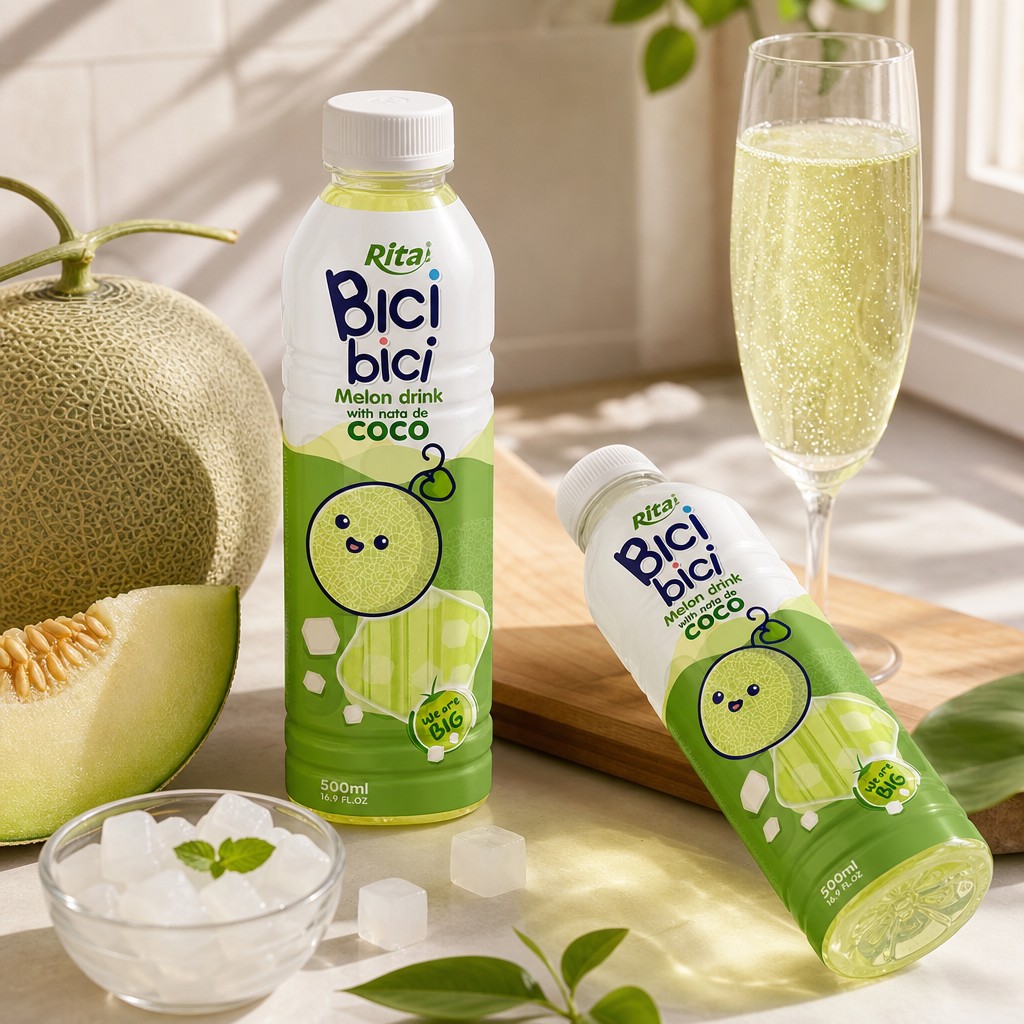
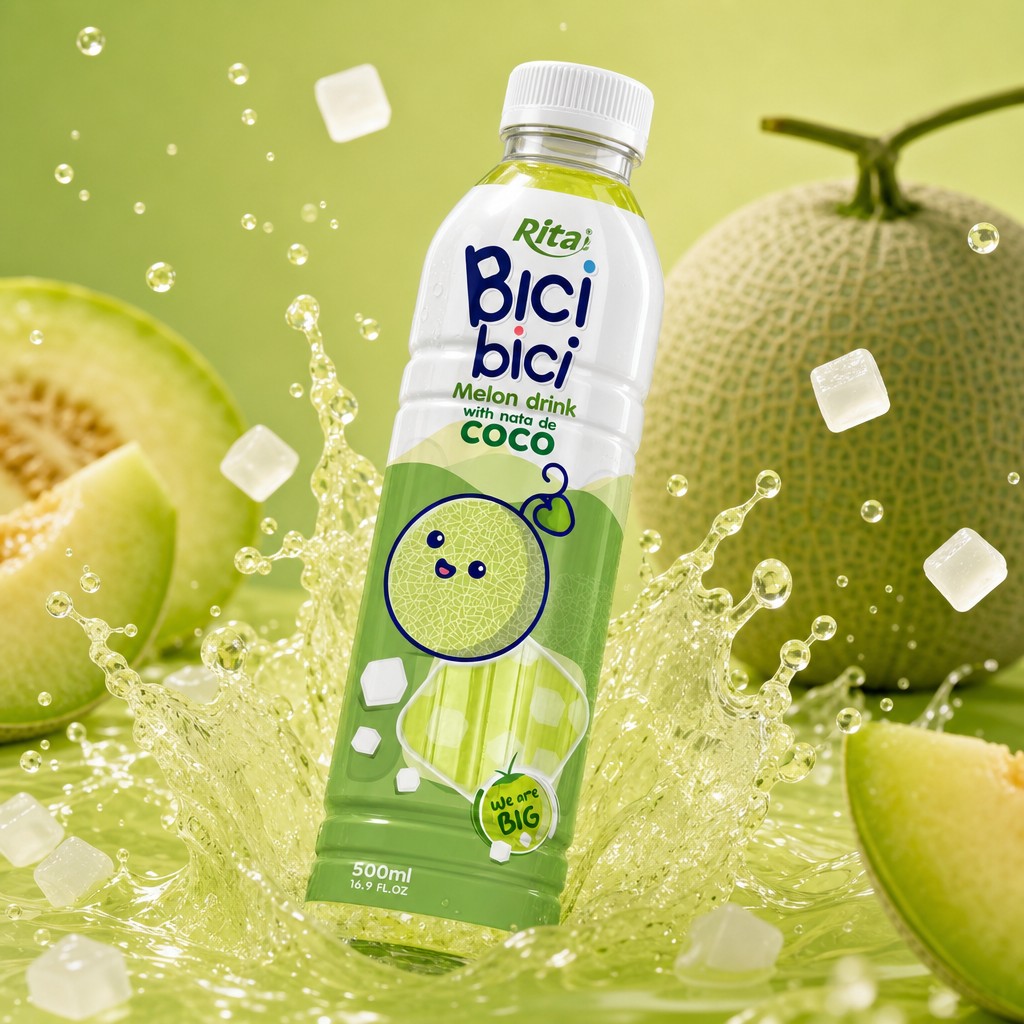
The choice of a transparent PET bottle is deliberate. Japanese consumers are accustomed to seeing the product before they buy it, and the visible nata de coco pieces floating in a pale green melon liquid create instant shelf differentiation. The playful cartoon melon character on the label — complete with a smiling face and the bold "we are BIG" badge — reinforces a friendly, approachable brand image that works particularly well in the 18-to-35 demographic.
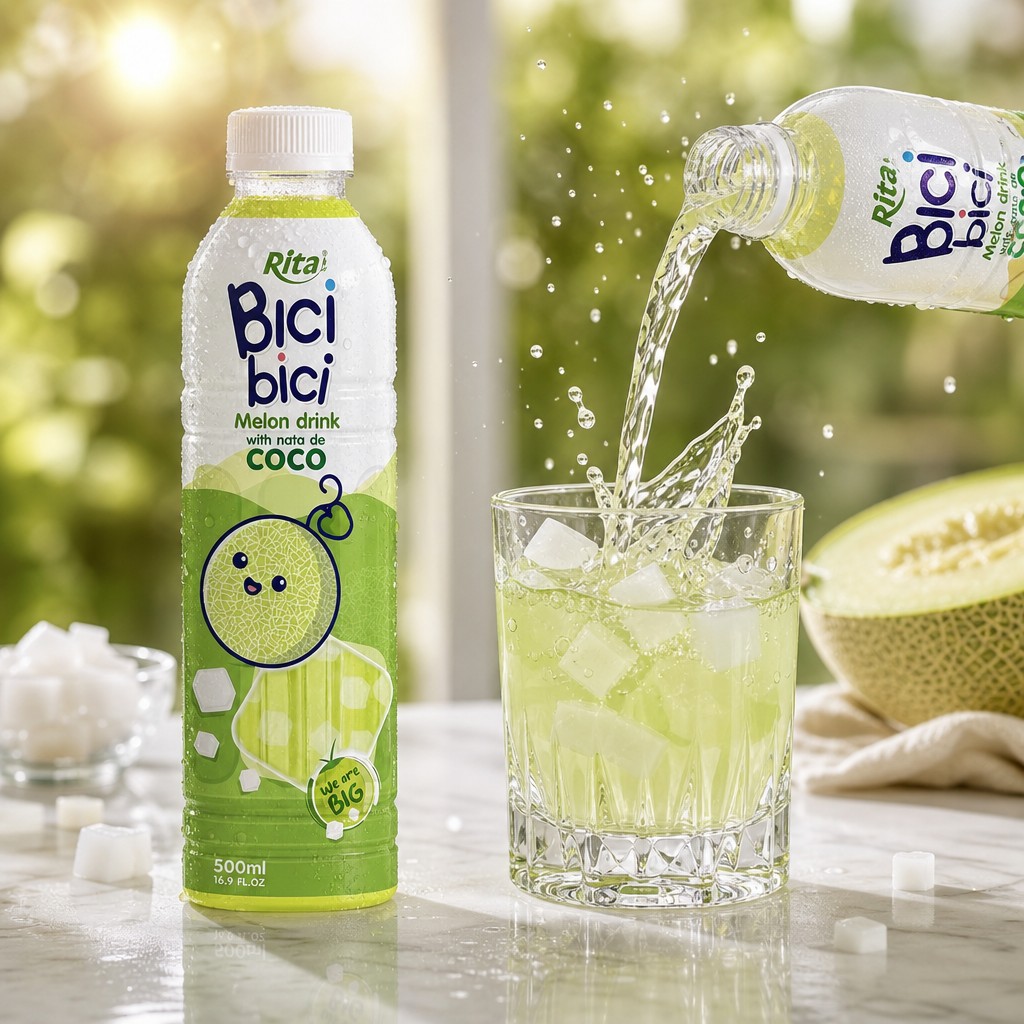
In both the 500 ml and 1 L sizes, the packaging communicates volume and value without sacrificing the premium feel that Japanese and Korean shoppers expect. The 500 ml version fits neatly into standard convenience store coolers, while the 1 L format targets household consumption and on-the-go sharing occasions.
Japan and South Korea as Priority Markets for Bici Bici
Japan's non-alcoholic beverage market was valued at over 7 trillion yen in recent years, with flavored waters, fruit drinks, and textured beverages capturing an outsized share of new product launches. South Korea, meanwhile, has seen its RTD (ready-to-drink) category grow steadily, driven by a combination of convenience store expansion, rising health-consciousness among younger consumers, and a strong cultural affinity for fruit-forward flavors.
Within this landscape, melon holds a unique position. It is one of Japan's most iconic flavors — deeply tied to summer, to gift-giving culture, and to a premium perception that few other fruits can match. Korean consumers, for their part, have embraced melon in everything from ice cream to flavored milk. A Rita Bici Bici Melon Drink that pairs this familiar taste with the textural intrigue of nata de coco speaks to both markets simultaneously.
RITA's export infrastructure supports this dual-market approach. The company ships through Ho Chi Minh Port and maintains production capacity of approximately 600 twenty-foot containers per month, providing the supply chain resilience that large East Asian retail networks require. Lead times of 20 to 25 days after order confirmation keep the product competitive against regional alternatives.
OEM and Private-Label Flexibility
One of the strategic advantages of working with RITA Food & Drink Co., Ltd is the company's willingness to customize. The Bici Bici Melon Drink with Nata de Coco can be produced under the RITA brand or as an OEM and ODM private-label product, giving Japanese and Korean distributors the ability to develop exclusive SKUs for their own retail networks.
That flexibility extends to flavor variation as well. The Bici Bici line is also available in chocolate, coffee, honey, and strawberry, allowing partners to build a complete flavor portfolio around a single product concept. For retailers seeking to launch a branded texture-drink range without investing in product development, this is a significant shortcut.
Certification and Compliance for East Asian Retail
Entering the Japanese and Korean markets demands rigorous compliance. Japanese retailers, in particular, require suppliers to demonstrate adherence to internationally recognized food safety standards. RITA's certification portfolio covers the critical bases: BRC, FSSC 22000, Halal (both Jakim and HCA-GCC), Kosher, ISO, GMP, and HACCP. These certifications are not simply bureaucratic markers — they are prerequisites for shelf placement in major chains such as 7-Eleven Japan, Lawson, and GS25 in South Korea.
The presence of SMETA (Sedex Members Ethical Trade Audit) certification further strengthens RITA's position. Japanese and Korean buyers increasingly evaluate suppliers not only on product quality but also on ethical labor practices and environmental responsibility. SMETA compliance provides a documented assurance that production meets those expectations.
What Buyers Should Request
Prospective importers are advised to request full certification documentation during the initial sourcing conversation. RITA provides free samples — a critical step for any buyer evaluating a new product line. The company's minimum order quantity is described as flexible, which typically means production runs can be calibrated to match the scale of a market entry, whether that is a test shipment of a few hundred cases or a full container load for national distribution.
Payment terms are structured around L/C and T/T, standard instruments that Japanese trading houses and Korean distributors are well accustomed to managing.
The Melon Flavor Opportunity in East Asian Convenience Culture
Convenience stores are the primary retail channel for RTD beverages in both Japan and South Korea. In Japan alone, there are more than 55,000 convenience stores, and new product introductions in the chilled beverage section turn over at an extraordinary pace. Products that fail to capture attention within the first two to three weeks of shelf placement are typically delisted to make room for the next wave of launches.
This is where the Bici Bici Melon Drink with Nata de Coco has a structural advantage. The product is visually distinctive — the pale green liquid with visible chewy pieces creates a moment of curiosity at the shelf edge. The melon character on the label adds personality without relying on the restrained minimalist design that dominates much of the Japanese beverage aisle. In a sea of understated packaging, a bit of playfulness can be the difference between a glance and a pick-up.
For South Korean convenience chains, the product's dual-size strategy is equally relevant. The 500 ml PET bottle targets the single-serve impulse purchase, while the 1 L format suits the growing "home consumption" segment that has gained momentum since the pandemic.
Flavor Development and Consumer Testing
Melon is not a flavor that requires consumer education in East Asia. Japanese consumers associate it with premium gifting — the iconic gift melon — and with summer refreshment. Korean consumers have grown up with melon-flavored snacks, desserts, and beverages. The risk of market rejection based on unfamiliarity is minimal, which lowers the barrier for importers evaluating new product lines.
The addition of nata de coco adds a layer of novelty that can be marketed as a "discovery" element. In trend-driven markets like Tokyo and Seoul, products that offer a small surprise — a new texture, an unexpected ingredient combination — tend to generate social media buzz that amplifies their commercial impact far beyond the initial shelf placement.
Sourcing Considerations for Japanese and Korean Buyers
For procurement teams evaluating the Rita Bici Bici Melon Drink with Nata de Coco, several factors stand out. The product ships FOB from Ho Chi Minh Port, which offers competitive freight rates to both Yokohama and Busan. Production lead times of 20 to 25 days are consistent with industry standards for the RTD category, and the 600-container monthly capacity provides confidence that supply can scale with demand.
The PET bottle format is lightweight and shatter-resistant, reducing logistics costs and breakage risk compared to glass alternatives. For Japanese buyers operating on tight margin structures, the cost-to-shelf ratio is a meaningful consideration.
RITA's broader product portfolio — spanning coconut products, fruit juice products, and soft drinks — means that importers can consolidate orders across multiple SKUs, potentially negotiating better freight and payment terms than they would with a single-product supplier.
Building a Long-Term Supply Partnership
RITA Food & Drink Co., Ltd has been in operation since 2004, and the company's export track record spans more than two decades. For Japanese and Korean buyers, that longevity matters. Beverage supply chains are built on consistency — consistent quality, consistent lead times, consistent communication. RITA's established infrastructure and long-standing relationships with logistics providers reduce the operational risk that smaller or newer manufacturers might introduce.
The company's willingness to support both branded and private-label production also positions it as a partner rather than a mere vendor. Buyers who develop exclusive SKUs with RITA gain a degree of product differentiation that is difficult to replicate through commodity sourcing.
Market Outlook and Strategic Positioning
The convergence of three trends — texture innovation, melon flavor popularity, and convenience store growth — creates a favorable environment for the Rita Bici Bici Melon Drink with Nata de Coco in Japan and South Korea. As the RTD market continues to fragment, with consumers increasingly choosing products that offer a specific experience rather than simply quenching thirst, brands that can deliver on taste, texture, and visual appeal will capture disproportionate shelf space.
For Japanese and Korean importers, the product offers a relatively low-risk entry into the textured beverage segment. The melon flavor is culturally familiar, the nata de coco adds a genuine point of differentiation, and the PET format is optimized for the dominant retail channel. Combined with RITA's manufacturing scale, certification portfolio, and flexible OEM capabilities, it is a product that merits serious evaluation for any buyer building a beverage portfolio aimed at East Asian consumers.
The broader lesson is that the future of RTD beverages in Asia is not just about what a drink tastes like — it is about what it feels like, what it looks like on the shelf, and whether it creates a moment worth sharing. The Bici Bici Melon Drink with Nata de Coco is designed with all three of those dimensions in mind, and that is what makes it a product worth watching.
Frequently Asked Questions
What sizes are available for the Rita Bici Bici Melon Drink with Nata de Coco?
The product is available in two PET bottle formats: 500 ml and 1 L. The 500 ml version is designed for single-serve convenience store consumption, while the 1 L format targets household and on-the-go sharing occasions.
Is the Bici Bici Melon Drink suitable for private-label or OEM production?
Yes. RITA Food & Drink Co., Ltd offers both branded and OEM/ODM production. Japanese and Korean distributors can develop exclusive private-label SKUs using the Bici Bici platform, including custom labeling and branding.
What certifications does the product carry?
The Rita Bici Bici Melon Drink with Nata de Coco is produced under BRC, FSSC 22000, Halal (Jakim and HCA-GCC), Kosher, ISO 22000, GMP, and HACCP certifications. These credentials cover the compliance requirements of most major Japanese and Korean retail chains.
What is the minimum order quantity for the Bici Bici Melon Drink?
RITA maintains a flexible MOQ policy. Exact minimum quantities depend on the production run and packaging configuration, and the company provides free samples for evaluation prior to order confirmation.
How long is the production lead time?
Standard production lead time is 20 to 25 days after order confirmation, with shipments departing from Ho Chi Minh Port, Vietnam. RITA's monthly export capacity exceeds 600 twenty-foot containers.
Buyers interested in exploring the Rita Bici Bici Melon Drink with Nata de Coco or other products in the RITA portfolio can request samples and pricing details through the company's official channels. The full OEM service catalog provides additional information on customization options, while the RITA about-us page offers background on the company's history and export capabilities.