

Electrolyte Cans Meet Tighter Rules in Global Beverage Trade
TABLE OF CONTENTS
-
- What certifications support the 490ml Cucumber and Lime Electrolyte Juice Drink for export?
- What are the typical specifications of the cucumber and lime electrolyte drink?
- Can the formulation and packaging be customized for private-label orders?
- What are the order and shipping terms for this product?
- Where can I review the full product details and request a sample?

The global beverage industry is entering a period of sharper regulatory scrutiny, and electrolyte juice drinks packaged in aluminum cans are at the center of the conversation. As importers, retailers, and private-label buyers across Asia-Pacific and beyond tighten compliance checklists, manufacturers with deep export experience are finding that certification depth and formulation transparency matter as much as flavor. Against this backdrop, the 490ml Cucumber and Lime Electrolyte Juice Drink in Aluminum Can from RITA reflects how a classic refreshment profile can be reworked for modern labeling, packaging, and cross-border trade expectations. Buyers evaluating suppliers for electrolyte juice drinks now ask harder questions about shelf life, ingredient declarations, and batch-level documentation, and the answers increasingly determine whether a container order clears customs without delay.
Key Takeaways
- Regulatory attention on beverage labeling, additive declarations, and packaging materials is rising across major import markets.
- Aluminum-can formats remain attractive for electrolyte juice drinks because of shelf stability, recyclability credentials, and premium shelf presence.
- Cucumber and lime profiles align with consumer demand for crisp, lower-sugar botanical flavor directions.
- Export-ready suppliers with multi-market certifications reduce compliance risk for importers and private-label partners.
- Flexible MOQ, documented COA processes, and 24-month shelf life strengthen commercial viability for container-scale orders.
Regulatory Pressure Reshapes Electrolyte Juice Drink Sourcing
Compliance teams are no longer treating electrolyte juice drinks as simple refreshments. They are classifying them within a web of additive rules, sweetener limits, mineral-declaration standards, and packaging migration requirements that differ market by market.
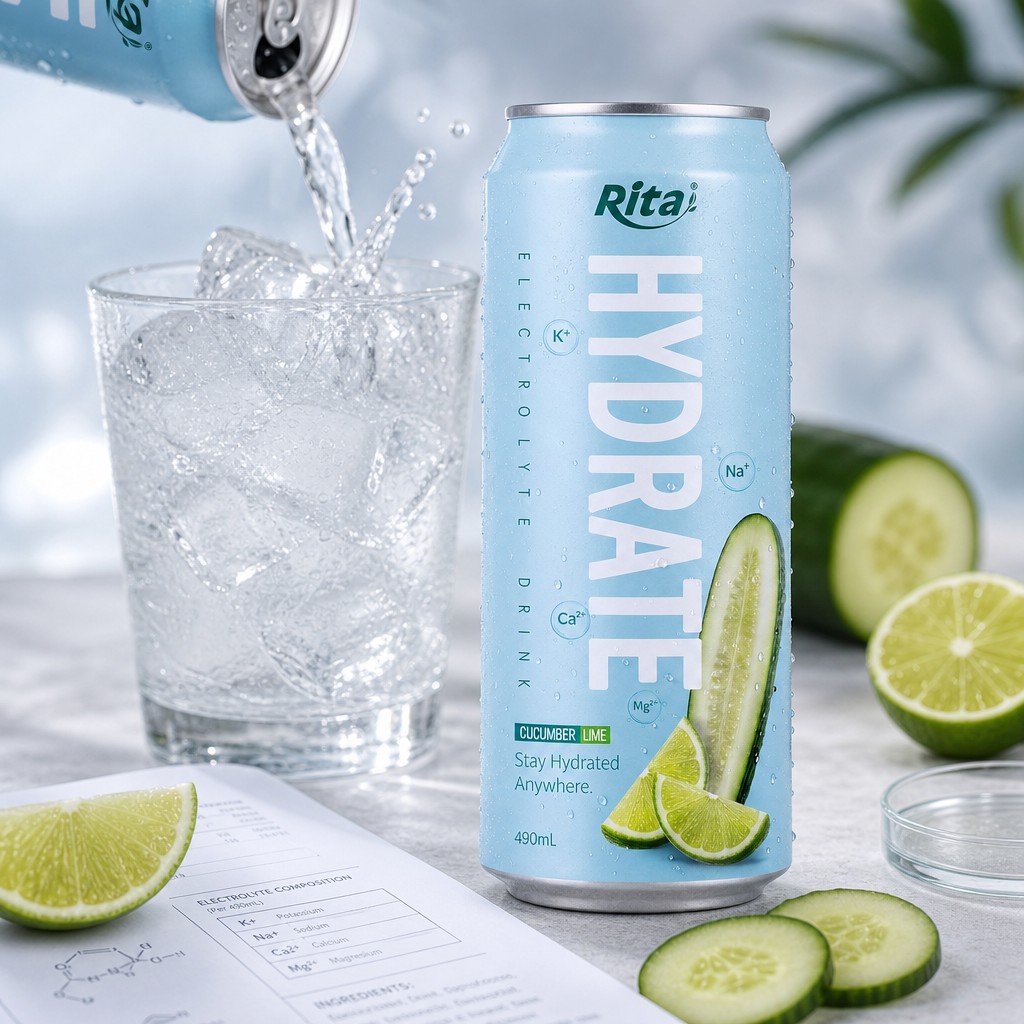
The 490ml Cucumber and Lime Electrolyte Juice Drink is formulated around water, cucumber juice, lime juice, sugar, cucumber and lemon flavor, and ascorbic acid, with an electrolyte mineral blend of potassium, sodium, calcium, and magnesium. That composition keeps the ingredient panel short and readable, an advantage when importers submit dossiers for label review. Typical specifications of pH 4.2±0.5 and Brix 2.0±0.5 give technical teams a stable reference point when aligning local nutrition tables and additive declarations.
For buyers in Japan and Korea, where shelf-label accuracy and additive naming conventions are closely monitored, a concise formulation reduces the chance of re-labeling requests. Importers across Honshu, Hokkaido, Kyushu, and Shikoku, as well as distribution hubs in Seoul, Busan, Incheon, Daegu, Daejeon, and Gwangju, increasingly ask suppliers to provide a Certificate of Analysis with each production batch alongside the standard specification sheet. The ability to supply that documentation on schedule is becoming a commercial differentiator in tenders for convenience-store placements and travel-retail listings.
Aluminum-can packaging adds another compliance layer. Food-contact migration testing for can linings, BPA-related inquiries in certain jurisdictions, and recycling-content expectations are now standard parts of retailer questionnaires. A 490ml can sized for lunchboxes, gym bags, and cup holders meets portion expectations while giving buyers a format that aligns with extended shelf-life claims of 24 months, simplifying inventory planning across long ocean transit routes.
Product Experience Meets Clean Label Expectations
Flavor still decides whether a listing reorders, and cucumber-lime has emerged as one of the more distinctive directions in the electrolyte category.
Opening a can releases a crisp cucumber aroma lifted by bright lime top notes. The profile sits at a deliberate midpoint, not overly sweet and not sharply tart, with a light finish that encourages repeat sips. At 8 kcal per 100ml and 2g of total sugar, the drink appeals to consumers who track sugar intake without seeking an extreme zero-sugar product. The 490ml can delivers roughly 39 kcal and 9.8g of sugar per serving, figures that fit comfortably within mainstream low-sugar positioning in convenience and grocery channels.
Design That Supports Shelf Communication
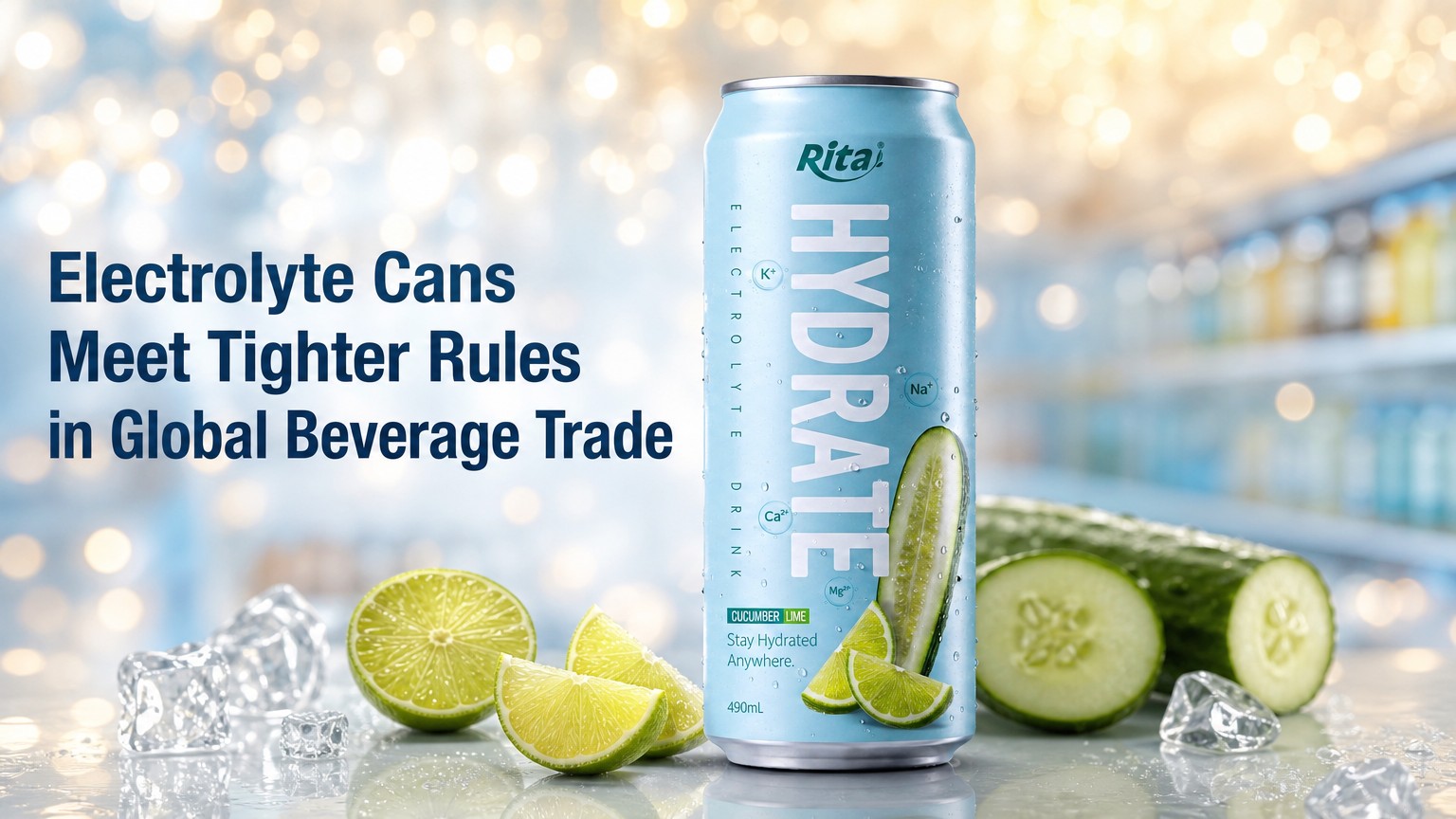
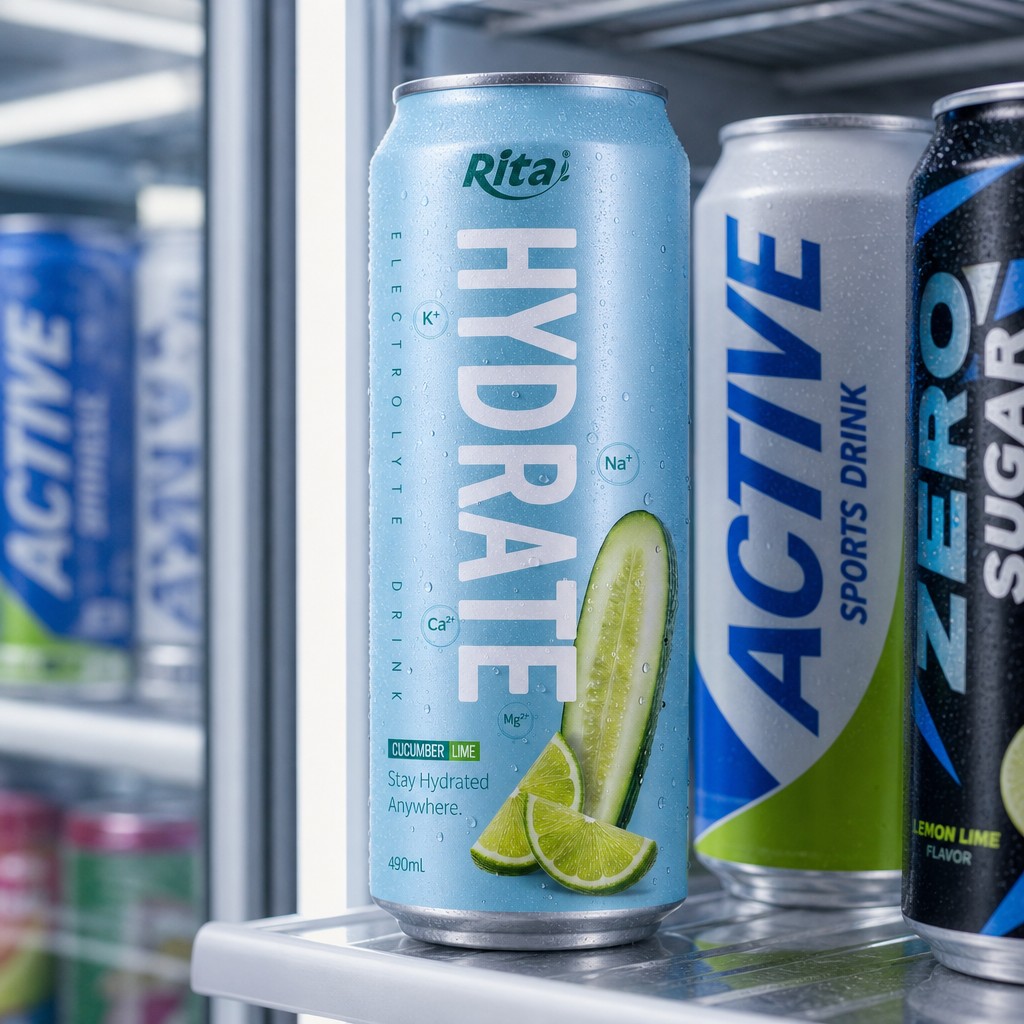
The can body carries a light blue field with silver rims at top and bottom, vertical white HYDRATE lettering, and ELECTROLYTE DRINK running alongside it. Sliced cucumber and lime wedges with water droplets anchor the visual story, while small icons for K+, Na+, Ca2+, and Mg2+ communicate the mineral blend at a glance. The tagline Stay Hydrated Anywhere reinforces the on-the-go use case without overloading the panel with claims. For retailers that cap on-pack messaging, this balance of imagery, mineral icons, and restrained copy makes the can easier to approve during label review cycles.
Neutral, taste-led language on pack also supports compliance. The product description focuses on refreshment, flavor, and consumption occasion rather than physiological outcomes, which keeps the brand clear of the health-claim gray zones that regulators have been tightening in recent years. Buyers assembling private-label ranges can therefore position the drink alongside iced teas, coconut water, and flavored stills without triggering additional claim-review steps.
Certification Stack Underpins Cross-Border Shipments
For container-scale orders, the certificate folder travels with the product, and gaps there can stall a shipment at the port.
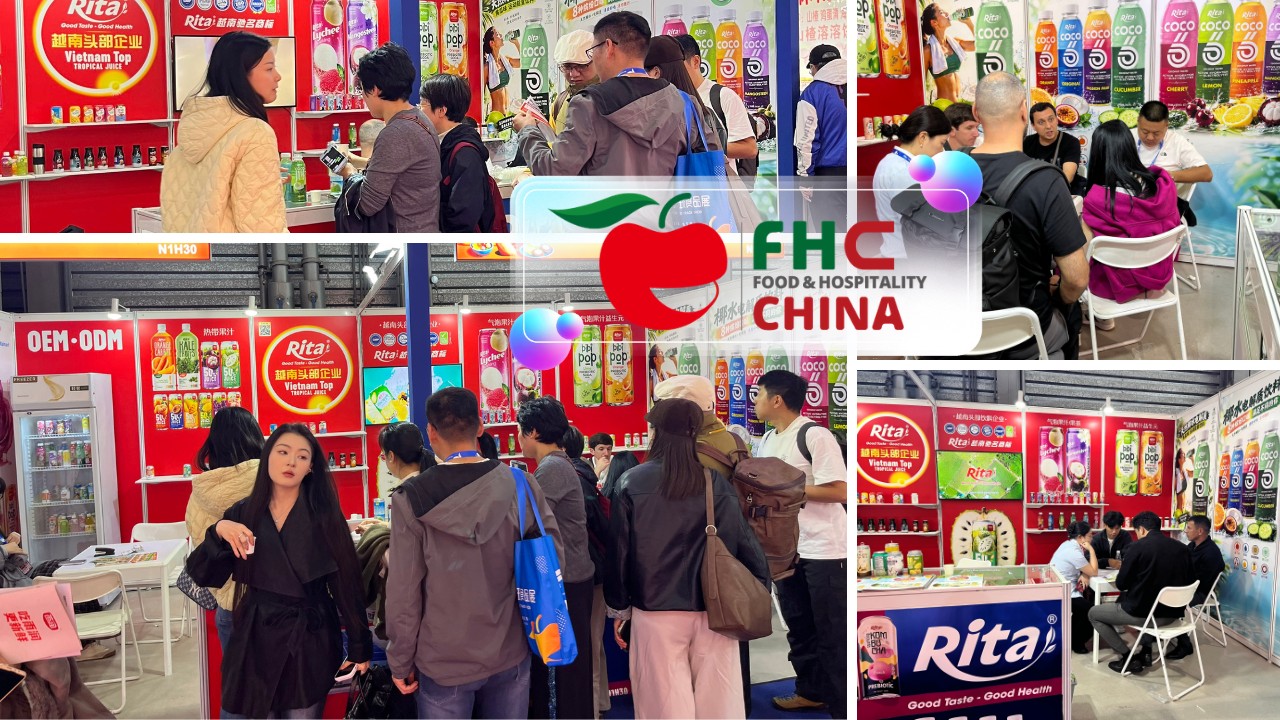
RITA Food and Drink Co., Ltd., established in 2004, operates with a certification portfolio that includes BRC, FSSC 22000, Halal Jakim, Halal HCA-GCC, Kosher, ISO, GMP, HACCP, and SMETA. Not every certificate applies to every SKU, but the breadth allows export managers to assemble the right set for each destination's import file. Halal coverage supports shipments into Muslim-majority markets that re-export into broader Asian networks, while BRC and FSSC 22000 align with the audit expectations of European and Middle Eastern retail groups.
That certification depth matters for the 490ml Cucumber and Lime Electrolyte Juice Drink in Aluminum Can because electrolyte positioning invites extra documentation requests. Buyers want confirmation that mineral additions are declared correctly, that flavor systems meet additive schedules, and that batch COAs match the label panel. A supplier able to answer those requests from a standing documentation library shortens approval cycles from weeks to days.
Supply capability rounds out the compliance picture. With more than 50 automated production lines and a reported supply ability of 600 twenty-foot containers per month, the manufacturer can sustain large roll-out programs without forcing buyers into phased, inconsistent batches. Delivery windows of 20 to 25 days after order confirmation, flexible minimum order quantities, and shipment from Ho Chi Minh Port give procurement teams the scheduling room needed to align with retailer planograms.
From Our Orchards and Fields, Raw Material Sourcing in Focus
Regulators and retailers increasingly trace ingredient origins as part of due-diligence requirements, pushing beverage makers to document sourcing routes with the same rigor applied to production lines.
The Mekong Delta remains a cornerstone of that sourcing story. Details on how the region supplies high-quality raw ingredients are outlined in the Mekong Delta raw material area report, which describes the agricultural base behind juice and drink inputs used across the company's portfolio.
Lime, a defining note in this electrolyte juice drink, draws on Vietnam's established citrus supply chains. The journey from orchard to bottle for citrus-based beverages is documented in the orchard behind the company's citrus sourcing, offering buyers a reference point for how fruit inputs move from field collection into beverage production.
Field-level footage from the Mekong Delta operations is available at https://www.youtube.com/watch?v=jiBixXjeG8A for teams that prefer visual verification during supplier audits.
Traceability documentation of this kind feeds directly into retailer questionnaires. When a buyer asks for origin statements, pesticide-residue test references, or supplier declarations, having published farm narratives alongside formal COAs helps compliance officers close requests without escalating to on-site audits.
Market Positioning for Japan and Korea Distribution Networks
Convenience-store culture in Japan and Korea rewards drinks that are easy to merchandise, simple to explain, and visually distinct in a crowded cooler door.
The cucumber-lime direction fits that environment. It sits apart from mainstream citrus and berry SKUs, giving buyers a flavor story that supports shelf differentiation without requiring staff education. The 490ml can matches common single-serve sizes in urban stores across Honshu, Hokkaido, Kyushu, and Shikoku, while distribution centers serving Seoul, Busan, Incheon, Daegu, Daejeon, and Gwangju can move the format through existing chilled and ambient logistics without new handling protocols.
Electrolyte positioning also travels well across demographics. Office workers buying a mid-afternoon drink, commuters grabbing a can at a station kiosk, and fitness-adjacent consumers picking up a post-session refreshment all encounter the same product without the brand needing separate SKU variants. That single-SKU versatility reduces listing complexity for importers managing dozens of items per container.
For private-label programs, the manufacturer offers OEM and ODM routes, allowing buyers to adjust formulations, sweetness levels, mineral blends, and pack artwork while retaining the underlying production and certification framework. The Cucumber and Lime Electrolyte Juice Drink product page outlines typical specifications, and buyers can request customized parameters during the sampling stage.
Industry Headwinds and Why Compliance Depth Matters More
Recent headlines across the beverage sector underline how quickly regulatory or operational issues can reshape commercial plans.
PepsiCo's decision to close a US bottling site, Diageo and Pernod's Scotch import practices under investigation in India, Amber Beverage UK entering administration, a probe into a toxic spill at a Diageo site in Scotland, and Canned Wine Group's acquisition of South African brand New Theory collectively illustrate a market where operational and compliance missteps carry immediate financial weight. For importers, these stories reinforce a simple procurement principle: choosing suppliers with documented quality systems and transparent sourcing reduces exposure to sudden disruption.
Electrolyte juice drinks sit in a category that regulators watch closely because mineral additions intersect with food-additive schedules, labeling rules, and, in some markets, claims frameworks. A supplier that can produce specification sheets, batch COAs, and certification copies on request is not just operationally convenient; it is commercially protective. The 490ml aluminum-can electrolyte drink is backed by a documentation approach designed around that reality.
Broader Portfolio Context for Category Buyers
Buyers rarely order a single drink in isolation, and portfolio fit often determines whether an electrolyte SKU earns a container slot.
The manufacturer's wider range spans tropical fruit juices, coconut products, functional drinks, energy drinks, and more, packaged in aluminum cans, glass bottles, PET, and PP bottles. That breadth lets importers build complementary line-ups from one supplier relationship. Buyers exploring adjacent categories can review the fruit juice product catalog for still and nectar options, or the soft drinks catalog for carbonated and flavored refreshments that pair naturally with an electrolyte can on the same shelf.
Private-label teams benefit from the same infrastructure. A single qualification process can cover multiple formats, reducing the duplicated audit work that typically slows multi-SKU launches. For companies evaluating OEM partnerships, the OEM service overview details how formulation, artwork, and packaging decisions move from brief to production.
Export scale further supports category ambition. The company reports shipments to more than 200 countries and territories, with over 1,200 containers leaving monthly. That volume underpins consistent raw-material procurement and production scheduling, factors that show up as steadier lead times and fewer allocation surprises during peak seasons.
What Buyers Should Ask Before Placing an Order
Procurement teams can accelerate approvals by focusing supplier conversations on documentation and format specifics rather than broad marketing claims.
- Request the Certificate of Analysis template for the electrolyte juice drink and confirm which parameters are batch-tested.
- Verify which certifications apply to this SKU versus the broader company portfolio.
- Confirm aluminum-can lining specifications and any migration test reports required by the destination market.
- Review label-copy options for mineral declarations to ensure alignment with local naming conventions.
- Discuss flexible MOQ thresholds and how artwork changes affect lead time from the standard 20 to 25 day window.
- Ask about pallet configurations and container loading plans for 490ml cans to optimize freight cost per unit.
Free samples are available for sensory evaluation and preliminary label checks, giving quality teams a tangible reference before committing to a purchase order. Payment terms of L/C and T/T, FOB pricing on request, and shipment from Ho Chi Minh Port round out the commercial framework for first-time and repeat buyers alike.
Frequently Asked Questions
What certifications support the 490ml Cucumber and Lime Electrolyte Juice Drink for export?
The manufacturer holds BRC, FSSC 22000, Halal Jakim, Halal HCA-GCC, Kosher, ISO, GMP, HACCP, and SMETA certifications. Not every certificate applies to every SKU, so buyers should confirm the applicable set for this aluminum-can electrolyte juice drink during the quotation stage.
What are the typical specifications of the cucumber and lime electrolyte drink?
Typical specifications include a 490ml aluminum can, 24-month shelf life, pH 4.2±0.5, and Brix 2.0±0.5. Ingredients are water, cucumber juice, lime juice, sugar, flavors (cucumber, lemon), and ascorbic acid, with an electrolyte blend of potassium, sodium, calcium, and magnesium.
Can the formulation and packaging be customized for private-label orders?
Yes. OEM and ODM options are available, allowing buyers to adjust formulations, sweetness, mineral blends, artwork, and packaging while working within the existing certification and production framework.
What are the order and shipping terms for this product?
Minimum order quantities are flexible, delivery time is 20 to 25 days after order confirmation, payment terms include L/C and T/T, and FOB pricing is provided on request. Shipments depart from Ho Chi Minh Port, Vietnam.
Where can I review the full product details and request a sample?
The product listing at https://ritadrinks.com/product/490ml-cucumber-and-lime-electrolyte-juice-drink-in-aluminum-can includes technical specifications, nutrition facts, and inquiry contacts. Free samples are available for evaluation.